
Moving from the United States to Dubai is not one administrative event. A business owner or property buyer must coordinate a Dubai residence route with U.S. filing, foreign-account, banking and document questions that can continue after departure.
This guide is a planning checklist for U.S. citizens and residents. It does not determine tax residence, calculate tax, decide whether a reporting form applies or promise approval of a UAE residence application. Those conclusions require the current rules, the person’s facts and, where appropriate, qualified U.S. and UAE advisers.
In this guide, you will learn:
- how to separate the Dubai route from continuing U.S. obligations;
- which tax and foreign-account questions to document;
- how to prepare personal documents for the named UAE recipient; and
- how to keep company, property, banking and family decisions in the right order.

Choose the Dubai route before fixing the moving date
Start with the activity or asset that supports the intended Dubai plan. A company-led route, a property purchase and a family move create different dependencies. None should be treated as automatic proof that a UAE residence application will be approved or that a U.S. obligation has ended.
| Route under review | Question to settle first | Detailed DRI guide |
|---|---|---|
| Dubai company | What will the company sell, where will it operate and who will own and manage it? | Company setup and residence checklist |
| Dubai property | Does the property make sense independently of a residence outcome? | Property purchase and residence routes |
| Family move | Which dependent, school, housing and document decisions depend on the principal route? | Family relocation checklist |
If the operating model is not yet clear, use the free zone versus mainland guide before comparing incorporation packages. Keep the proposed UAE timeline separate from any conclusion about U.S. filing, residence or tax.
Map the U.S. filing questions that may continue abroad
The IRS states that U.S. citizens and resident aliens abroad generally remain subject to U.S. filing rules and consider worldwide gross income when determining filing requirements. Living in Dubai therefore does not, by itself, remove every federal filing obligation. It also does not mean that every person owes the same tax or qualifies for the same exclusion, credit or treaty position.
Build a dated adviser file rather than relying on a generic “tax-free Dubai” statement. Record citizenship and immigration status, expected travel dates, sources of income, company ownership, signature authority, investments, homes and family locations. Ask a qualified adviser which returns, elections, information forms and state-level questions apply to those facts.
| Evidence group | Facts to record | Question for the adviser |
|---|---|---|
| Identity and travel | Citizenship, immigration status and actual days by jurisdiction | Which federal and state rules remain relevant? |
| Income and ownership | Employers, clients, entities, accounts and investments | Which income and information filings may apply? |
| Authority | Directorships, signature rights and account control | Does authority create a reporting or governance issue? |
| Household | Family locations, homes and planned move sequence | Which facts affect the advice or filing calendar? |
Keep FBAR and Form 8938 as separate tests
FinCEN explains that a U.S. person may have to file an FBAR when the aggregate value of foreign financial accounts exceeds the applicable threshold at any point in the calendar year. The IRS separately explains that Form 8938 covers specified foreign financial assets under its own rules and thresholds. One filing is not automatically a substitute for the other.
Create an account register before opening or closing UAE accounts. Include the institution, account owner, beneficial owner, signatories, currency, highest available balance evidence and opening or closing date. Add personal, joint and company accounts for adviser review without deciding in advance which are reportable. A Dubai business account has a separate onboarding process; the founder evidence checklist covers the UAE bank’s entity and transaction review.
Prepare authenticated documents for the named recipient
The U.S. Department of State notes that people planning residence or employment in the UAE may be asked for authenticated personal documents. The actual requirement depends on the recipient and purpose. An employer, immigration service, licensing authority, school, bank or other institution may ask for a different original, copy, translation or authentication path.
- Name the receiving organisation and the exact purpose before ordering authentication.
- Ask which issuing authority, copy type, translation and validity period it accepts.
- Track the original location, issue date, authentication steps and recipient confirmation.
- Do not assume acceptance by one UAE organisation proves acceptance by another.
Keep entry permission, residence and work authority separate
Short-visit entry arrangements do not establish a right to live or work in Dubai. Confirm the current entry requirements for the traveller, then confirm the residence and work process attached to the chosen Dubai route. Avoid booking irreversible household commitments against a tourist-entry assumption.
Use a dependency list for each applicant: route owner, authority, required evidence, submission event, current status and the next commitment that depends on it. A company licence, residence application, Emirates ID process, housing choice and family sponsorship may interact, but they are not the same approval.
Use five evidence gates before irreversible commitments
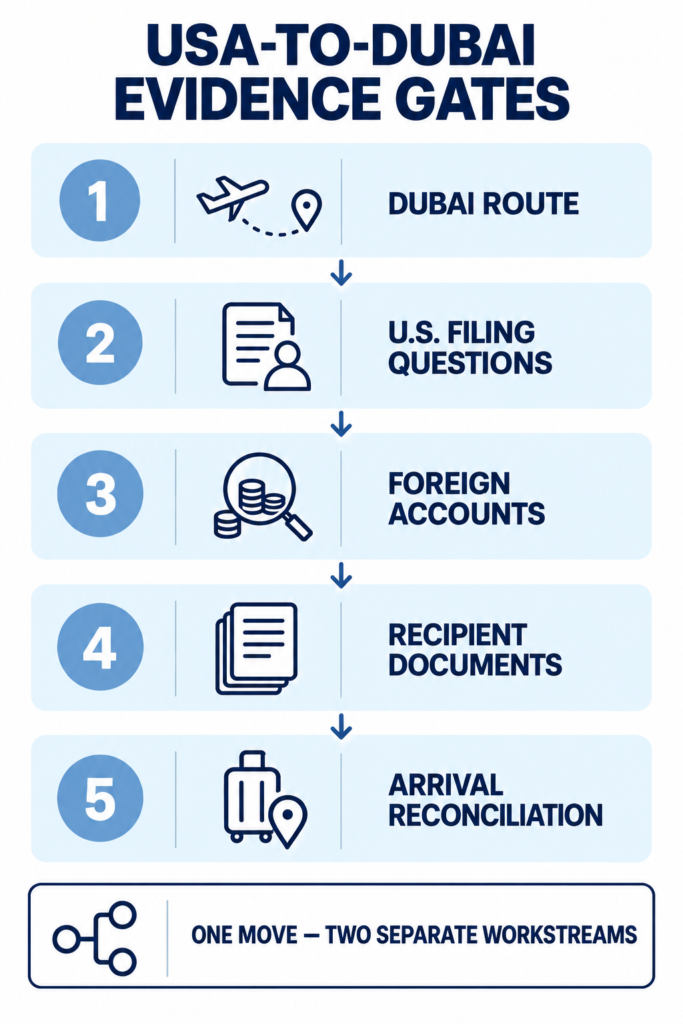
| Gate | Evidence to reconcile | Commitment to keep reversible |
|---|---|---|
| Dubai route | Named company, property or family route and current authority checklist | Final departure, housing and operating dates |
| U.S. filing questions | Adviser brief, income, ownership and travel facts | Closure of records needed for a return or election |
| Foreign accounts | Account owners, signatories, dates and highest-balance evidence | Account closure or transfer before reporting advice |
| Recipient documents | Named UAE recipient, purpose and accepted authentication path | Bulk authentication or surrender of originals |
| Arrival reconciliation | Actual travel, accounts, identity records and open requests | Closure of U.S. arrangements that still provide a fallback |
These gates are evidence reviews, not processing-time promises. Reopen the plan when an applicant, route, ownership structure, travel date or household sequence changes.
Frequently asked questions
Does moving to Dubai end U.S. tax filing?
Not automatically. The IRS publishes rules for U.S. citizens and residents abroad. The applicable returns, exclusions, credits and information filings depend on the person’s facts.
Is an FBAR the same as Form 8938?
No. FinCEN and the IRS describe separate tests, thresholds and reporting scopes. Ask an adviser to review both rather than treating one as a substitute.
Should every U.S. document be authenticated?
No. Confirm the document, purpose and accepted chain with the named UAE recipient before ordering work.
Planning a U.S.-to-Dubai move?
DRI can help organise the Dubai-side company or property route and its dependencies. U.S. tax, reporting and document conclusions remain with the relevant authorities and qualified advisers.
Official sources checked on 17 September 2026: IRS guidance for U.S. taxpayers abroad and FATCA reporting, FinCEN FBAR guidance, and the U.S. Department of State UAE country information. Rules and individual outcomes can change; confirm the current position before acting.