
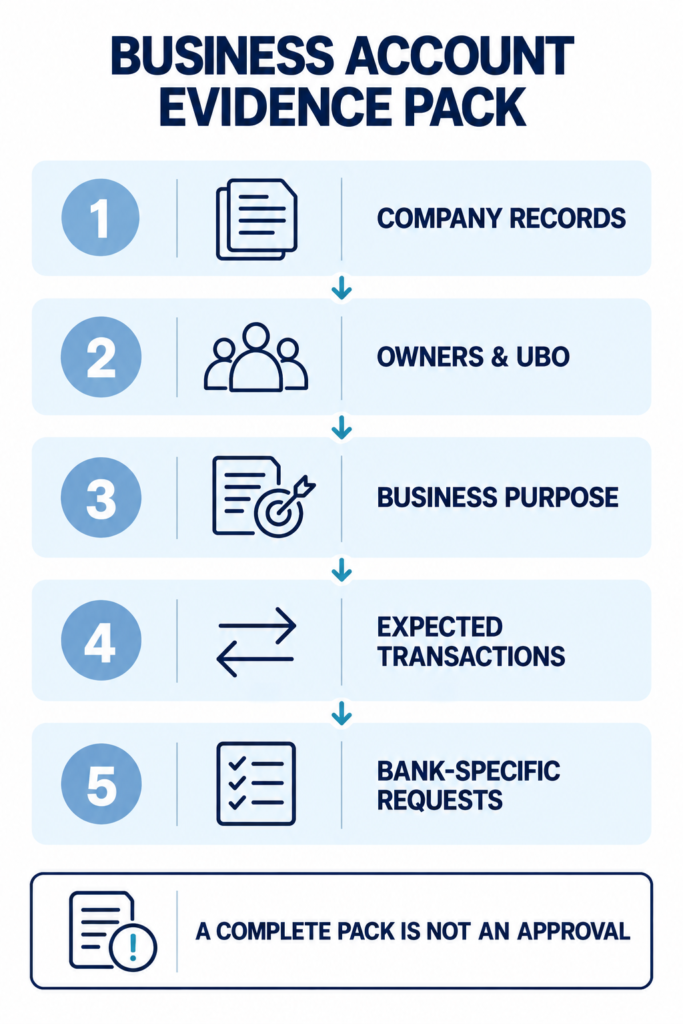
Opening a Dubai business bank account is not an automatic final step after receiving a trade licence. The bank must understand the legal entity, its owners and authorised people, what the business will do, why the account is needed and what transactions are expected. A complete-looking folder can still produce follow-up questions if those facts do not agree.
This guide helps a new founder prepare an evidence pack before approaching a bank. It does not rank banks, reproduce one institution’s list as a UAE-wide rule, predict an opening time or promise approval. Each bank applies its own product and risk criteria within the regulatory framework.
In this guide, you will learn:
- how to make the licence and company records internally consistent;
- how to map owners, beneficial owners and signatories;
- what to include in a business-purpose and expected-flow file; and
- how to compare bank-specific requests without assuming approval or timing.

Start after the company facts are stable
Before opening an application, confirm that the issued licence and constitutional records reflect the company you intend to operate. If the actual product, service, customer or delivery model does not fit the selected activity, solve that licensing question first. Our Dubai business activity guide provides the pre-licence question set, while the company setup and residence checklist covers the broader formation sequence.
| Company fact | Source record | Consistency question |
|---|---|---|
| Legal name and form | Licence, certificate and constitutional documents | Are the names and legal form identical across current records? |
| Licensed activity | Issued trade or commercial licence | Does the business explanation match what is licensed? |
| Registered and operating address | Licence, lease or facility evidence where applicable | Can each address be explained and evidenced? |
| Authority to operate the account | Constitutional document, resolution or mandate as applicable | Who can apply, sign and give instructions? |
Do not describe initial approval, a reserved name or a formation invoice as an issued operating licence. Do not submit an old draft structure if the shareholders, managers or activities changed during formation. Version every record and use the current issued set.
Build one owner, UBO and signatory map
The Central Bank of the UAE’s customer-due-diligence rules require licensed financial institutions to identify and verify customers and beneficial owners, understand the ownership and control structure, and identify relevant persons who manage or act for a legal entity. This is broader than collecting one shareholder’s passport.
Create a simple ownership chart from the applicant company through every direct and indirect owner to the natural persons who ultimately own or control it. Beside the chart, list directors, managers, authorised signatories and anyone acting under a power or resolution. Record which current document supports each relationship.
| Person or entity | Role | Evidence to organise | Open question |
|---|---|---|---|
| Applicant company | Account holder | Licence, registration and constitutional records | Which current record establishes the entity? |
| Shareholder chain | Direct and indirect ownership | Registers and entity documents for each layer | Are all percentages and names reconciled? |
| Ultimate beneficial owner | Natural person ownership or control | Identity and ownership/control evidence | What verification will the chosen bank require? |
| Manager or signatory | Management or account authority | Identity plus resolution, mandate or constitutional authority | Who may submit and operate the account? |
Do not rely on a single percentage threshold as the entire UBO analysis. Ownership and control facts can require a wider review, and the bank may request additional information. If another company sits in the chain, prepare its current records rather than explaining it only in an email.
Explain the business in the language of evidence
CBUAE rules require a financial institution to understand the nature of a legal person’s business and the purpose and intended nature of the relationship. A broad statement such as “consulting” or “international trade” rarely explains what will happen in the account.
Write a factual one-page business note. State the product or service, customer types, delivery method, countries involved, reason for the UAE entity, how revenue is earned and why the account is required. Attach current evidence that exists, such as signed or draft customer and supplier documents, invoices from an earlier business, a website or operating plan. Label forecasts as forecasts.
- Activity: use wording that reconciles with the issued licence.
- Counterparties: distinguish expected customers, suppliers and related parties.
- Delivery: state where work, goods or digital services are delivered.
- Revenue: explain the commercial event that creates an invoice or payment.
- Evidence status: separate executed records, current negotiations and projections.
Prepare an expected-transaction profile
The account-use description should connect to the business note. Estimate the expected number and size range of incoming and outgoing payments, main currencies, countries, payment purposes, related-party flows and initial funding. State the basis for each estimate. A new company may have projections rather than history, but projections should still be commercially explained.
| Flow | Record the expected facts | Possible support |
|---|---|---|
| Initial funding | Contributor, amount range, purpose and sending account | Ownership records and source evidence requested by the bank |
| Customer receipts | Countries, currencies, frequency, amount range and service/product | Contracts, proposals, invoices or operating plan |
| Supplier payments | Supplier type, countries, purpose and amount range | Quotes, agreements or purchase records |
| Payroll and expenses | Expected headcount, timing and operating categories | Employment or budget records where applicable |
| Related-party flows | Entity relationship, purpose and pricing basis | Group chart, agreement and tax/accounting advice |
Do not create transactions to make a new company appear established. If a material counterparty, country or payment type is uncertain, mark it as an assumption and ask the bank what information would be needed if it becomes real.
Separate source of funds from source of wealth
In higher-risk circumstances, enhanced due diligence can include stronger enquiries into source of funds and source of wealth. These terms answer different questions: where the particular money comes from, and how the relevant person accumulated their wider wealth. The bank decides what it needs for the application.
Build an evidence index without sending sensitive material before a secure request. List each document, owner, period, currency, translation status and the fact it supports. If money will move from a personal account into the company, record the legal and accounting basis and obtain appropriate advice rather than labelling every transfer “capital.”
Compare each bank’s current request separately
Emirates NBD, ADCB and Mashreq publish business-account information that includes items such as a valid UAE licence, constitutional documents, owner or partner identification, address information and, where applicable, resolutions or statements. The wording and eligibility are bank- and product-specific. None of those pages is a universal minimum list for every UAE bank.
| Comparison field | Bank A | Bank B | Bank C |
|---|---|---|---|
| Eligible entity and licence | Record exact published wording | Record exact published wording | Record exact published wording |
| Owners and signatories | List current request | List current request | List current request |
| Address and business evidence | List current request | List current request | List current request |
| Application channel and attendance | Ask and date the answer | Ask and date the answer | Ask and date the answer |
| Fees, balance and product conditions | Use current product document | Use current product document | Use current product document |
Do not select a bank from a headline opening time. Ask what has been reviewed, what remains conditional and whether additional documents can be requested. Keep a payment fallback until the account is actually active for the intended use.
Run a final consistency review before submission
- Licence activity matches the business note and website.
- Legal name, address, owners and managers match across current records.
- Ownership percentages reconcile through every layer to the UBO map.
- Account purpose matches the expected transaction table.
- Contracts and forecasts are clearly distinguished.
- Every follow-up request has an owner, due date and secure delivery method.
If the business activity, ownership, signatory or expected countries change, update the full pack before reusing it. The goal is not to eliminate questions; it is to answer them with consistent records and avoid building payroll or commercial deadlines around an unconfirmed account.
Frequently asked questions
Can a free-zone company open a UAE business account?
A free-zone company can apply for business banking. Approval is bank- and case-specific, and the bank will assess the entity, owners, business and intended account use. Do not describe free-zone companies as unable to bank or as automatically approved.
How long does opening take?
There is no reliable period that applies to every bank and applicant. Product pages may describe a channel or headline process, but review time depends on the institution, entity, owners, activity, evidence and follow-up requests.
Does a complete checklist guarantee approval?
No. A checklist improves readiness and consistency. The chosen bank remains responsible for its assessment, additional requests and decision.
Planning the company before the bank application?
DRI provides an initial discussion to organise a Dubai company’s activity, structure, formation and relocation dependencies. A bank remains responsible for account eligibility, due diligence, product terms and approval.
Official sources checked on 15 September 2026: CBUAE Rulebook provisions on customer due diligence, legal persons, beneficial ownership and enhanced due diligence, plus current business-account information from Emirates NBD, ADCB and Mashreq. Bank eligibility, documents, products, fees and procedures can change and remain institution- and case-specific.