
A company licence is one part of a move to Dubai. You also need a business structure that fits what you will do, a residence route for which you qualify, and a practical plan for the household moving with you.
This guide is for business owners relocating through company formation. Start by defining the business activity and where your customers are, then compare jurisdictions and confirm the residence application separately. A formation package should answer all three questions before you commit.
- Decide what the company needs permission to do.
- Understand the sequence from setup decisions to licensing and residence.
- Build a document list, a comparable budget and an arrival plan.

Write the business brief before comparing packages
Describe the actual transaction your company will make: what it sells, who pays it and where the work takes place. “Consulting” is a starting point, but a licensing authority may need a more precise activity. The UAE Ministry of Economy and Tourism explains that economic activity determines the relevant legal form and licence.
Bring a one-page brief to an initial discussion. Include the owners, current country of residence, expected customer countries, whether goods or services are involved, any regulated work, intended premises, and the people who need residence. Add whether an overseas company will remain active. This makes it easier to spot a setup that looks inexpensive but does not fit the business.
A filled one-page business brief
Illustrative example: “The company will provide operations consulting to small technology businesses. Customers will be in the UK, Europe and Dubai. Work will be delivered online and, when contracted, at a customer’s Dubai office. The sole owner is a British citizen relocating from the UK. There are no employees at launch, but the plan should allow one owner residence application and later recruitment. No stock, importing, public retail or regulated financial advice is planned. A UK company will remain active for existing contracts until tax and contract advice is completed. The owner needs a bank account for customer receipts and ordinary suppliers. A partner and child may join after the owner’s status is in place.”
This example does not select a licence or jurisdiction. It gives the authority or adviser testable facts. Ask them to return the proposed activity wording, licensing authority, legal form, market-access limits, facility assumption, additional approvals, residence category and every fact that would change the recommendation. If “consulting” produces several activity choices, attach sample deliverables and a draft invoice description rather than choosing the broadest label.
Choose a jurisdiction for the business you will operate
Dubai offers mainland and free-zone company options. Use the official comparison to identify the relevant authority, then confirm the precise activity and market access it allows. An office address, a residence entitlement and permission to perform a particular activity are different questions.
For example, a business serving overseas clients online and one delivering services at customers’ Dubai premises should not select a jurisdiction simply because their owners want the same residence outcome. Map the operating model first. Our Free Zone vs Mainland guide provides a side-by-side decision checklist.
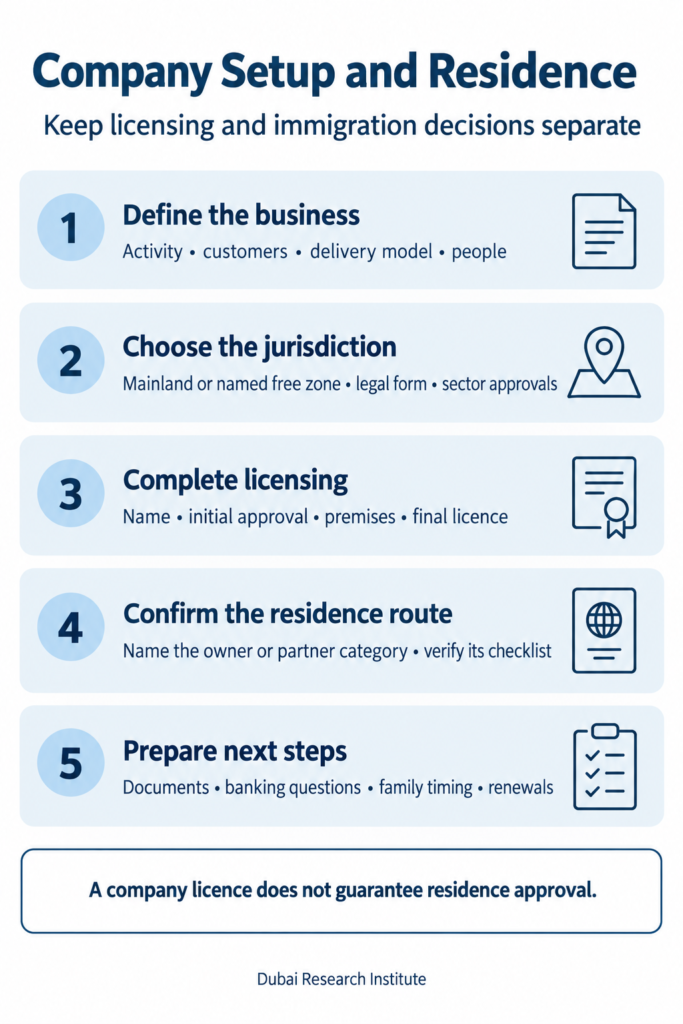
Follow the licensing sequence
The Ministry’s company formation guide sets out the mainland sequence: choose the activity and legal form, register a trade name, obtain initial approval, prepare the applicable constitutional documents and business address, obtain any additional approvals, submit documents, and obtain the licence. It also lists Chamber registration. Free-zone procedures follow the chosen authority’s requirements.
Initial approval allows the setup process to proceed; the Ministry expressly distinguishes it from permission to operate. Keep each approval and its purpose in the project file so that a reservation or preliminary approval is not mistaken for a completed licence.
| Decision or milestone | What to ask before moving on |
|---|---|
| Activity and legal form | Does the proposed licence describe the actual work and ownership structure? |
| Name and initial approval | What has been approved, what remains conditional, and when does the approval expire? |
| Premises and additional approvals | Is the proposed facility accepted for this activity and intended staffing? |
| Final licence | Have the approved activity, owners, address and renewal date been checked? |
| Residence application | Which immigration category applies to the owner, and who confirms eligibility? |
Put the relevant licensing authority’s name and evidence beside every milestone. The Ministry’s mainland overview describes the activity-to-licence sequence, while the selected authority supplies the case-specific forms and approvals. A named free-zone authority handles companies in its jurisdiction. Identify the relevant Dubai setup authority before accepting a provider’s package description.
| Named decision owner | Milestone evidence to retain | What it does not prove |
|---|---|---|
| Relevant mainland licensing authority, or named free-zone authority | Activity selection and legal-form record | Final permission to operate |
| Same licensing authority | Trade-name and initial-approval records | Licence issuance; initial approval is preliminary |
| Licensing authority plus sector authority, where required | Applicable constitutional, premises and additional-approval documents | Owner residence approval |
| Licensing authority | Final licence showing activity, owners and renewal reference | Bank account or tax outcome |
| GDRFA or applicable immigration authority/service | Named route checklist, company/owner evidence and submission record | Automatic approval for every founder |
Confirm the owner’s residence route separately
GDRFA Dubai provides a separate Green Residence service for investors and partners. Its published checklist includes a passport, photograph, partnership or investment documents and trade licence, and its conditions require the competent authorities’ approval. This is one defined immigration route; it does not mean every newly registered company owner automatically receives Green Residence.
Ask the formation provider or competent authority to identify your proposed residence category by name. Confirm the applicant requirements, company documents, immigration-file steps, any in-country appointments, medical and identity procedures that apply, and the dependencies between them. If a quote includes a “visa”, establish exactly which application stages and charges that covers.
For a family move, ask when dependants can apply and what evidence the sponsor must provide. A company’s capacity to apply for visas and the owner’s ability to sponsor family members should be checked separately. Use the family relocation checklist to coordinate those steps with housing and schooling.
Prepare documents against the chosen route
Request a written checklist for your selected authority and ownership structure, rather than collecting every document mentioned in a generic setup guide. Separate documents for the company, the individual owner and accompanying family. For an existing overseas corporate shareholder, specifically ask which corporate records, resolutions and authentication steps will be needed.
Check that names are consistent across passports and company records. Record which documents require originals, certified copies, translation or attestation, and who will accept them. For foreign-issued documents, the UAE Ministry of Foreign Affairs directs applicants to the relevant UAE mission and document-attestation process. The procedure depends on the issuing country and document.
Build four packs and let the recipient confirm each list. The company pack can track the business brief, proposed activity, name and initial-approval records, constitutional documents, premises evidence, additional approvals and final licence. The owner pack can track passport and photograph files, ownership or partnership evidence, current address/contact details and the named residence-route checklist. These are working folders, not universal statutory checklists.
If an overseas company will own shares, create a separate corporate-shareholder pack: incorporation and constitutional records, current ownership/control evidence, board or shareholder authority for the investment, signatory evidence and the recipient’s authentication instructions. For an accompanying household, keep a family pack for each person with civil records, passport records, school or insurance requirements and the dependent route’s current instructions. Never send the whole archive by default; use a disclosure list showing which recipient received which version.
- Name files by person or entity, document type, issue date and version.
- Add a “requested by” field and link to the written checklist.
- Flag spelling differences before forms are submitted.
- Record originals separately from working scans and translated copies.
Compare the first year and the cost of keeping it running
A useful quote separates licence and registration charges, premises, immigration-related items, residence applications, medical and identity steps, document preparation, professional assistance and renewals. Mark each line as included, excluded, refundable or recurring. Ask whether changing the activity, owners or facility later creates a separate charge.
Keep company expenditure separate from personal relocation spending. Temporary accommodation, school deposits, family insurance and moving costs can fall due before the company is ready to operate. Comparing the same set of items is more useful than comparing two headline package prices.
Use one worksheet for initial and renewal quotes
Put each provider in a separate column, but keep the rows identical. Start with the confirmed activity and authority, then list name/initial approval, registration and licence, constitutional documents, premises or desk, sector approvals, establishment or immigration-file items, owner application support, family items, medical and identity coordination, banking support, document work and professional fees. Add a renewal column for every recurring item and a notes column for exclusions, assumptions and taxes.
| Worksheet row | Entry required from each quote | Change trigger |
|---|---|---|
| Licence scope | Authority, legal form and exact activities | New activity or regulated work |
| Facility | Included space, lease term and intended use | Staff, storage or visa need changes |
| People | Owner and employee application items separately | Household or hiring plan changes |
| Renewal | Recurring licence, facility and service items on the same scope | Price validity or package terms expire |
| Excluded work | Authority charges, third-party work and professional support omitted | Recipient requests new evidence |
Do not calculate a “cheapest” answer while a row is blank. Return the worksheet and request either a figure, “not applicable” with a reason, or “not included”. Then run a change scenario: one additional activity, one hire or a different premises requirement. The response shows whether the original package can adapt or whether the formation decision itself needs review.
Plan banking, tax administration and the first weeks
Treat bank onboarding as its own enquiry: ask the chosen bank which company and owner documents it needs, whether a meeting is required, and how the account will be used. Do not make a supplier payment date depend on an assumed account-opening date. Keep a contingency plan for operating funds.
Prepare a banking evidence pack
A bank needs to understand the entity, the people behind it and the proposed account activity on its own terms. Prepare a concise index with the final company records, beneficial owner and authorised-signatory identity files, address evidence requested by that bank, the business brief, expected customer and supplier countries, expected payment currencies, typical invoice size ranges, source-of-funds or source-of-wealth evidence requested, and examples of contracts, invoices or an operating history where available.
Keep the claims consistent. If the licence says consulting but the bank brief describes goods trading, stop and resolve the activity mismatch. If the new company has no invoices, label forecasts as forecasts and explain the evidence behind them; do not manufacture trading history. Record every follow-up request, its owner and the file supplied. The practical output is a traceable pack that answers “who, what, where and how funds move” without treating a completed licence as a guarantee of bank onboarding.
Arrange tax advice for the company and the owner before moving existing contracts or changing where the business is managed. A free-zone licence does not establish that all income is tax-free: the Federal Tax Authority’s guidance makes preferential treatment conditional. Immigration approval and tax treatment require separate assessment.
Finally, build the arrival schedule around confirmed appointments and documents. Leave space between immigration steps and commitments such as a long lease or a family’s school start. UK readers can use our UK departure guide alongside this setup checklist.
Discuss your business and relocation together
DRI supports people planning a Dubai move through company formation or property purchase. See our relocation support overview, then tell us what your business does, where you currently live, your intended move date and whether family members will accompany you. Those details provide a useful starting point for discussing the scope of support.
Official sources checked on 7 September 2026. This guide explains preparation and decision points; the relevant licensing and immigration authorities determine the requirements and outcome of an application.