
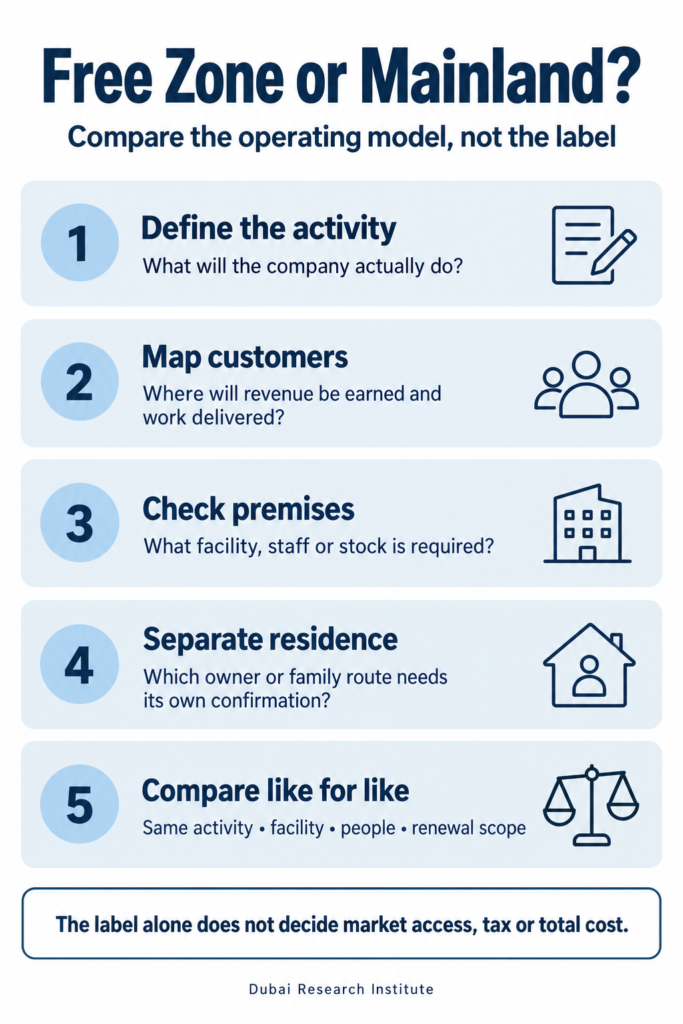
Choosing between a Dubai free zone and mainland company is a business-design decision before it is a relocation decision. The useful question is not “Which is cheaper?” but “Which structure can carry out the activity, serve the intended customers and support the owner’s move on the terms that apply to this case?”
This guide is for owners planning to relocate through a company. It does not recommend a particular free zone, quote setup prices or promise a residence outcome. A licence, tax position and residence application are connected workstreams, but they are not the same approval.
In this guide, you will learn:
- which questions should decide the jurisdiction before a quote is requested;
- why activity, regulator and market access matter more than a headline package price;
- how to assess ownership, premises, visa capacity and tax without relying on broad claims; and
- how to compare initial and renewal costs on the same assumptions.

Begin with the work the company must actually do
Write down the activity in operational terms: what will be sold, where the customer is located, whether staff will work from a physical site, and whether the activity is regulated. The UAE Ministry of Economy & Tourism explains that the economic activity defines the legal form and licence type, and that some activities need additional approvals. Check the official business-activity overview.
Mainland registration and licensing in Dubai sit with the relevant economic authority, while each free zone has its own authority and rules. The distinction affects the questions you need answered, the available facilities and the permissions attached to the licence. It should therefore be checked against the chosen activity, rather than inferred from another founder’s setup or a generic comparison chart.
Ask where revenue will be earned and delivered
Market access is often the key dividing line. Dubai’s official investment information says a mainland company may operate within and outside the UAE, and that a free-zone company needs a specific mainland licence to trade within the UAE. This is a high-level rule, not a reason to say that every free-zone business is uniformly unable to deal with UAE customers. The applicable activity, licence, additional permission and operating model must be checked with the relevant authority. Read Dubai’s company setup options.
| Decision area | Mainland | Free zone | Case-specific check |
|---|---|---|---|
| Activity and regulator | Registered and licensed through the relevant economic authority. | Registered under the selected free-zone authority. | Confirm the activity, legal form and sector approvals with that authority. |
| UAE market access | Dubai’s official investment information says mainland companies may operate within and outside the UAE. | A specific mainland licence is needed to trade within the UAE under Dubai’s high-level guidance. | Check the activity, licence and any additional permission for the operating model. |
| Foreign ownership | Many mainland companies can permit 100% foreign ownership. | Ownership is governed by the selected authority and structure. | Strategic-impact activities may require competent-authority approval. |
| Premises and visas | Premises and immigration steps depend on the activity and relevant authority. | Facility and visa capacity depend on the selected authority and arrangement. | Jafza, for example, ties its own visa numbers to the lease; do not generalise that rule. |
| Corporate Tax | Tax treatment depends on the entity’s facts and applicable rules. | 0% applies only to a Qualifying Free Zone Person’s Qualifying Income. | Review the income and structure; non-qualifying taxable income can be taxed at 9%. |
| Initial and renewal cost | No universal lower-cost outcome can be identified. | No universal lower-cost outcome can be identified. | Price the same activity, facility, people and renewal scope before comparing. |
Test the choice against three operating cases
The following cases are hypothetical and are not DRI client results or jurisdiction recommendations. They show how to convert a broad comparison into questions for the relevant mainland licensing authority or a named free-zone authority. Dubai’s official setup pages give high-level mainland and free-zone distinctions, but the activity, permissions and facility must be confirmed for the actual model. Review the mainland overview and the free-zone overview.
Case 1: services delivered on site in Dubai
Illustrative facts: an owner will sign contracts with Dubai businesses, and consultants will regularly perform work at customer premises. The first question is the exact service activity and how the company may contract and deliver it in Dubai. Ask the proposed authority to confirm the activity wording, any sector approval and the permission needed for that customer-facing model. A generic statement that a company “can work in the UAE” is too broad to retain as evidence.
- Evidence that decides: sample contract scope, delivery location, customer type and written authority confirmation.
- What it changes: the relative weight given to direct Dubai market access, premises and staffing.
- Uncertainty left: whether a specific regulated service or customer contract adds approval conditions.
- Re-open the decision if: work moves from online advice to on-site delivery, a new regulated service is added or the customer contract requires a different licence.
Case 2: online services for overseas clients
Illustrative facts: a solo owner delivers design and research online; current customers and payment counterparties are outside the UAE. The comparison can give more weight to whether the selected authority licenses that precise service, the facility included, owner residence steps and the recurring administration. It should still ask whether any Dubai customer work is expected. “Overseas clients today” is evidence about the starting model, not a permanent permission analysis.
- Evidence that decides: customer-country list, sample invoice wording, work-delivery method and a one-year sales plan.
- What it changes: the market-access scenario used for quote and licence comparisons.
- Uncertainty left: the authority’s exact activity mapping and the effect of future UAE business.
- Re-open the decision if: Dubai revenue becomes material, staff begin visiting customer sites, the company adds goods or the owner needs a larger facility.
Case 3: inventory, warehouse and distribution
Illustrative facts: a company will import packaged products, store inventory and distribute orders to UAE and overseas buyers. This case cannot be reduced to a virtual-desk package comparison. The product, importer role, customs/logistics path, permitted storage, warehouse location, staff and UAE sales model all need to be described before the authority and facility are compared.
- Evidence that decides: product list, origin/destination, importer and seller of record, warehouse specification, delivery flow and expected staff.
- What it changes: the weight given to facility permissions, logistics access, sector approvals and additional activity costs.
- Uncertainty left: product-specific approvals and the permissions needed across the chosen movement of goods.
- Re-open the decision if: the product category, importer, storage arrangement or UAE distribution channel changes.
A filled comparison method
Use a simple evidence register rather than a weighted score that hides unknowns. For the hypothetical online-services case, the register might read as follows:
| Decision test | Evidence in hand | Next decision action |
|---|---|---|
| Actual activity | Design research; sample deliverables attached | Obtain exact activity wording from each authority |
| Customer location | Current contracts outside UAE | Ask how proposed Dubai work would be handled |
| Delivery and premises | Online; no staff or stock at launch | Compare included facility and change path |
| Residence need | One owner plans to apply | Name route and separate its requirements |
| Renewal scope | One activity, same facility assumption | Request like-for-like initial and renewal quotes |
A row remains open until it has a document or a named authority answer. After comparing the completed register, write a short decision note: chosen authority and structure, evidence relied upon, unresolved questions, and the events that require a fresh check. This gives a later adviser or bank a usable record and prevents a decision made for a solo online business from being reused after the company adds Dubai delivery, people or stock.
Frame authority questions so the answer can be retained and compared. Instead of asking “Can a free-zone company trade in Dubai?”, state the proposed activity, customer, contract party, delivery location, premises and movement of goods, then ask what the proposed licence permits and what additional approval or mainland arrangement would be required. Use the same fact pattern for the mainland enquiry. If the answers rely on different assumptions, correct the worksheet before comparing them.
The final decision record should also name the losing option and why it was not selected on the present facts. That is not a permanent rejection. It makes future review faster: when a trigger occurs, the owner can see which evidence changed, which prior concern may now matter and which authority needs a fresh question.
Treat foreign ownership as an activity question
“Free zone means 100% ownership” is not a sufficient comparison. UAE law permits full foreign ownership of many mainland companies as well, while strategic-impact activities can remain subject to competent-authority requirements. The ownership question is therefore: does this chosen activity and legal form permit the proposed ownership structure under the current rules? Read the UAE Government’s foreign-ownership information.
That check also prevents an outdated “51% local partner” assumption from driving the decision. Do not replace it with the opposite assumption that any activity can be fully foreign-owned. Ask the authority or licensed adviser to identify the current rule for the named activity and jurisdiction, and retain the answer with the formation file.
Match premises and visa capacity to the household plan
A low initial package can be a poor fit if the company later needs a different facility, more visas or a regulated location. Visa capacity can depend on the authority and the facility. Jafza, for example, says visa numbers for its own companies depend on the lease agreement; that is an example of a named free zone’s rule, not a quota that applies across Dubai. Read Jafza’s visa guidance.
For a relocating owner, ask two separate questions: what does the company need to operate, and what residence route are you eligible to apply for? A company licence does not itself confirm approval of the owner’s residence application. If a partner or children will follow, keep their applications and household timing as a separate plan. See our family relocation checklist for the dependent workstream.
Do not turn a free-zone label into a tax conclusion
A free-zone company is not automatically taxed at 0%. The Federal Tax Authority says that a Qualifying Free Zone Person may receive the 0% Corporate Tax rate on Qualifying Income, while non-qualifying taxable income can be taxed at 9%. Whether a company and its income meet the conditions requires a review of the entity’s facts. Read the FTA’s Free Zone Persons guidance.
Tax treatment is also distinct from immigration. Do not choose a jurisdiction on the assumption that a tax headline resolves your UAE residence, UK tax or corporate compliance position. Bring the proposed activity, customer model and corporate structure to appropriately qualified advisers before relying on a tax outcome.
Compare the first year and renewal on the same scope
Request quotes that state exactly what is included. Compare licence issuance, activity additions, premises or desk arrangements, establishment or immigration-card steps where applicable, visa-related service charges, insurance, document work, renewals and any required compliance services. A quote is only comparable when the activity, facility, number of people and renewal assumptions are the same.
- What activity is included, and what approval could add time or cost?
- Where will the company contract, deliver and invoice its customers?
- What premises are required now, and what changes if the team or visa need grows?
- Which items are one-off, and which repeat at renewal?
- Which authority will confirm the licence, tax and residence questions for this case?
Turn the comparison into a formation plan
Once the jurisdiction is selected, the next task is to sequence the activity, legal form, name, approvals, licence, residence preparation and banking questions. Read our company setup and residency checklist for that process. DRI’s relocation support can help you prepare the decision questions before commitments are made.
Sources checked 7 September 2026: UAE Ministry of Economy & Tourism, Invest in Dubai, UAE Government foreign ownership, Federal Tax Authority, and Jafza.