
Moving to Dubai with family through company formation or property ownership works best when the principal applicant’s residence route and the household plan are built together. Family residence, school applications, housing and health cover have different requirements and rarely complete on the same day.
This checklist is for company owners and property investors moving with a partner and children. It does not replace the rules for an employment-sponsored household, and it does not treat a business licence or property purchase as automatic family-visa approval.
In this guide, you will learn:
- why the sponsor route comes before dependent applications;
- how standard family sponsorship differs from a property-investor Golden Residence checklist;
- how to manage school, housing, health cover and documentation in parallel; and
- how to keep a household plan viable if placement or immigration timing shifts.

Make the principal applicant’s route clear first
Standard dependent residence is tied to the sponsoring resident’s permit. The UAE Government portal says that a sponsor may bring eligible family members subject to the relevant rules, and that dependant permits are linked to the sponsor’s residence permit. That makes the sponsor’s route, status and document timeline the first dependency in the household plan. Read the UAE Government family-residence guidance.
For standard sponsorship, the same source currently states a minimum salary of AED 4,000 a month, or AED 3,000 plus accommodation, regardless of job title. Treat this as a published threshold to re-check before applying, not as a substitute for route-specific eligibility advice. It also lists spouses, unmarried daughters, sons under 25 and children with special needs among eligible categories, subject to conditions.
| Household route | Planning consequence |
|---|---|
| Standard resident sponsor | Check sponsor eligibility and dependent conditions as a separate application workstream |
| Dubai property-investor Golden Residence | Use the DLD family checklist for that service; do not generalise it to every family route |
Dubai Land Department’s property-investor Golden Visa service lists family documents including health insurance, a certified marriage contract and certified birth certificates for children. It is a Dubai-specific checklist for that service, not a universal UAE dependent-visa list. Check DLD’s current investor service requirements.
Where the family is joining a company owner, do not assume the company’s incorporation date is the family’s travel date. Incorporation, trade licensing, an owner or partner residence application, and dependant residence each have their own evidence and decisions; see the company setup and residency checklist. Where the family is joining a property investor, do not assume that a signed sale contract has the same effect as the property evidence required by a residence service; see the property-residency route guide. The sponsor should confirm the route first and then obtain the family checklist from the authority handling that route.
Run the documents workstream early
Build one folder per family member, with passports, civil records, school records and the receiving organisation’s requirements. Medical fitness testing applies to sponsored family members aged 18 or older under the standard family-residence rules. The required attestations, translations and formats can differ by document and recipient, so ask the authority, school or insurer before commissioning legalisation.
- Record passport expiry dates and document originals.
- Confirm marriage and birth-document certification requirements for your exact route.
- Ask the selected school for its age placement, seat, curriculum and international-transfer requirements.
- Keep digital copies and a version-controlled checklist, but travel with required originals when instructed.
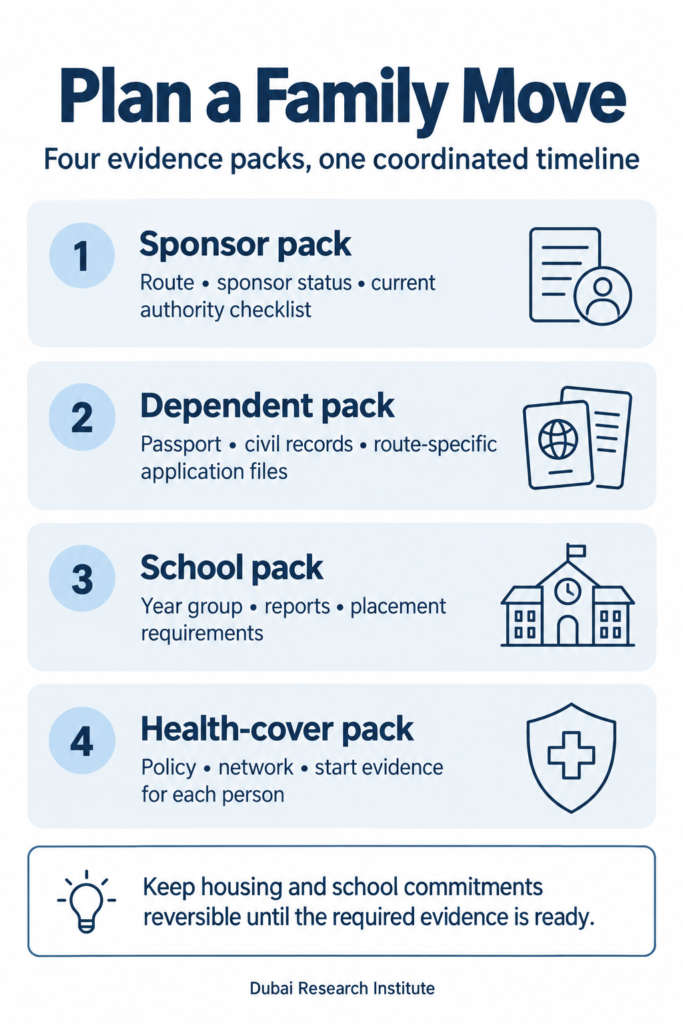
Build separate family document packs
Create a principal-sponsor pack, one dependent pack per person and one education pack per child. The sponsor pack should link the named residence route to the sponsor status and evidence required for family applications. Each dependent pack should track identity and civil records, the route-specific application checklist, medical or identity steps where applicable, and insurance evidence requested. The education pack should hold the child’s passport copy, previous-school evidence, reports and the selected school’s instructions.
Use a recipient column because the same record may need different handling. KHDA’s parent information says previous-school evidence matters above Grade 1 and describes translation or authentication questions for overseas certificates in languages other than Arabic or English. Confirm the precise requirement with the selected school before ordering work. Check KHDA’s current parent questions.
| Pack | Track | Gate before use |
|---|---|---|
| Sponsor | Route, status and family checklist | Authority confirms current route |
| Dependent | Passport, civil and application records | Names and recipient format match |
| School | Year group, reports and previous-school evidence | School confirms placement requirements |
| Health cover | Policy, network and start evidence | Provider confirms each person |
Treat schools as a separate placement decision
Schooling is not an automatic by-product of residence. In Dubai, ask the specific school about availability, academic records, assessment timing and documents for an entrant arriving from abroad. KHDA’s published rule directly addresses transfer certificates for pupils moving from another private school in the UAE; it should not be read as a universal overseas-transfer template. Read the KHDA resolution.
For UK households, GOV.UK says children aged 6 to 18 must attend school or be home-schooled in the UAE. That is a reason to begin school enquiries before locking a move date, while still allowing the chosen school to define its own admissions requirements. Read GOV.UK’s living-in-the-UAE guidance.
Housing and schooling are linked but should not be forced into one decision. A school’s location and the family’s commute can influence where to live, while a lease may need documentation that is still in progress. Start with a shortlist of areas and schools that can work for the family’s routine, then use temporary accommodation while you confirm what is available. This creates room for a school waitlist, a revised arrival date or a requirement to supply a refreshed document.
Move from the KHDA directory to a usable shortlist
Begin with the child’s required year group and the family’s acceptable curriculum transition. Use KHDA’s school information to compare curriculum, location, fees and performance, then contact the schools that pass those first filters. Ask each school to confirm seat availability, the applicable academic calendar, assessment or offer stage, documents, support relevant to the child and every deadline attached to an offer. Use KHDA’s enrolment guidance.
- Pass 1 — educational fit: curriculum, year group, calendar transition and relevant language or learning support.
- Pass 2 — actual availability: enquiry received, assessment requested, waitlist or written offer; do not label an enquiry as a place.
- Pass 3 — complete cost: school-year fee fact sheet, mandatory and optional charges, transport and the offer’s payment terms.
- Pass 4 — daily feasibility: morning and afternoon journey from realistic housing options to school and the adults’ regular work locations.
Use the school- and academic-year-specific fee fact sheet rather than tuition alone. KHDA’s fee guidance distinguishes mandatory and optional charges that should be read for the chosen school and year. Record the source document and date beside every amount; this article does not supply figures because they belong to the actual shortlist. Read KHDA’s School Fees Fact Sheet FAQs.
School and household worksheet
| Decision area | Evidence to enter | Family check |
|---|---|---|
| Curriculum and year | School-confirmed placement | Transition fits the child |
| Offer status | Enquiry, waitlist or written offer | Deadline and refund terms recorded |
| Fees | Current fee fact sheet | Mandatory, optional and transport separated |
| Support and school culture | Questions answered by school | Relevant needs can be discussed |
| Journey | Route at school-run times | Work and home routine remains workable |
| Housing | Temporary and long-lease options | Commitment matches evidence available |
Do not choose a home from a neighbourhood reputation alone. Test the family’s actual triangle: each child’s school, the adults’ regular work or business locations, and the housing option. Run the journey at relevant times and identify who handles drop-off if one adult has an immigration appointment or business meeting. A cheaper home can create an unworkable daily route; a preferred school can also become impractical if the only available place is far from the operating base.
Illustrative delay case
Hypothetical example, not a DRI client result: two parents and two children plan to join after the principal completes a company-based residence application. One child receives a school offer; the second remains on a waitlist. The offered school sets a response deadline while the family’s dependent checklist is still being confirmed. The household records the offer terms, asks the school what can be held or deferred, and keeps two temporary-housing locations open. It does not sign a long lease based only on the first offer.
The waitlisted child is later offered a place at a different campus. The family re-runs the school/work/housing worksheet instead of automatically accepting. If the two school journeys cannot work together, the decision options remain visible: ask about another intake, keep temporary housing longer, change the housing search area, or revisit the school shortlist. Meanwhile, the immigration folder remains separate, so a school delay is not misreported as a residence delay. The purpose of the contingency is to preserve choices until the household has both documented status and a daily routine it can actually operate.
Hold a short household review before any offer, lease or travel deadline. Put three dates on the page: the recipient’s real deadline, the family’s internal decision date and the date by which missing evidence must be chased. Then write who can make the decision if one parent is unavailable. This turns a busy relocation week into a small number of explicit gates instead of several commitments made from different email threads.
- Proceed: required evidence is available and the daily plan works.
- Hold: keep a reversible option while one named dependency remains open.
- Re-plan: route, school place, support need, journey or housing assumption has changed.
Keep one household handoff sheet with current sponsor status, each family member’s next document, each child’s school status, temporary-housing end date and the next non-refundable commitment. Update it from the underlying packs rather than replacing them. The sheet lets both adults see the same dependencies without treating an informal update as authority, school or provider confirmation.
Budget for timing, not only recurring costs
A practical family budget separates one-off transition costs from recurring household commitments. List deposits and temporary accommodation, insurance, document and translation work, school application or assessment costs, transport, furnishings and a buffer for overlap between home-country and Dubai arrangements. Do not make a long lease or non-refundable school commitment on the assumption that an immigration step will complete by a particular date.
Health cover belongs in the same early plan. Coverage requirements and provider onboarding can affect when each family member can use services, and UK arrangements should not be assumed to travel with the household. Compare the scope, exclusions, network and start date against your actual move sequence. Keep the policy evidence with the civil documents and make sure the responsible adult can access it during travel and the first weeks after arrival.
Use a delay-resilient family checklist
- Before travel: confirm the principal route, prepare civil documents, compare health cover and begin school enquiries.
- During the principal application: maintain temporary-housing options and keep school records ready without assuming admission or visa timing.
- After the sponsor’s status is in place: submit the appropriate family applications, complete route-specific medical and identity steps, then finalise longer-term housing and school arrangements.
- If timing changes: ask the authority or school which date-sensitive documents must be refreshed, rather than reusing an old checklist.
Plan the household around the route you can document
DRI’s relocation support can help you map the decisions across company formation or property ownership, residence preparation and household logistics. Individual approvals remain with the relevant authority and service provider.
Sources checked 7 September 2026: UAE Government family residence, Dubai Land Department investor service, KHDA resolution, and GOV.UK living in the UAE.