
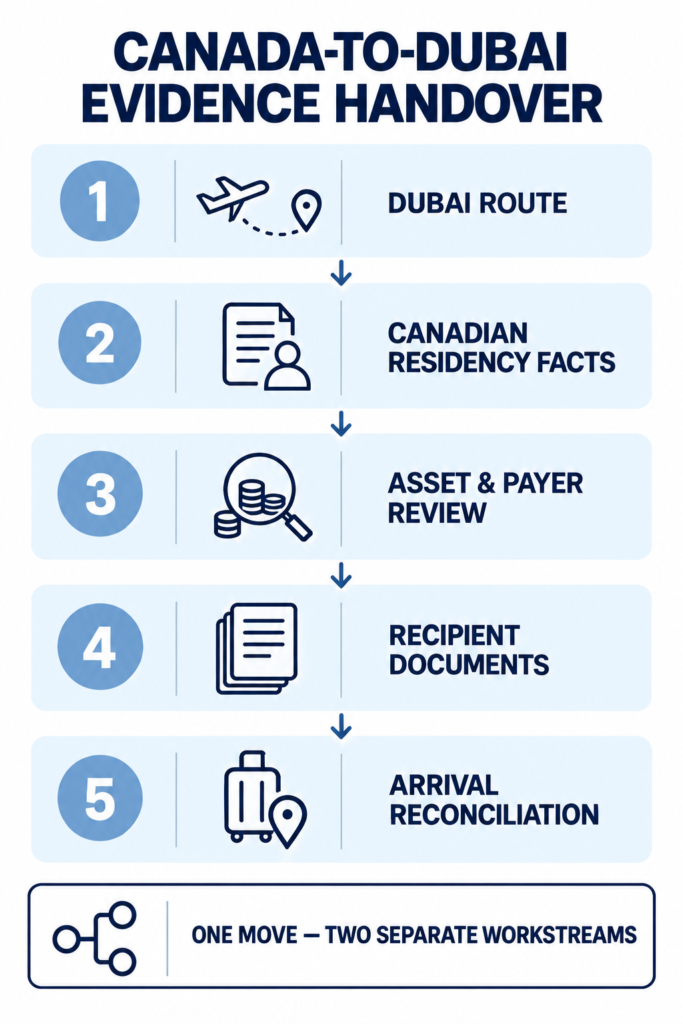
Moving from Canada to Dubai is not completed by obtaining one UAE document or booking a flight. A business owner or property buyer must coordinate two separate workstreams: the Canadian departure facts that may affect tax, assets, payments and documents, and the Dubai route that supports the intended residence and day-to-day plan.
This guide focuses on the Canadian side of that handover. It does not decide whether you are a Canadian non-resident, calculate departure tax or promise approval of a Dubai residence application. Those outcomes depend on individual facts and the current requirements of the relevant authority.
In this guide, you will learn:
- how to choose the Dubai route before fixing the departure sequence;
- which Canadian tax-residency and asset questions to document;
- how to check authentication requirements for Canadian documents; and
- how to keep banking, household and authority tasks evidence-based.

Define the Dubai route before the Canadian departure date
Begin with the activity or asset that makes the move workable. A company-led route and a property-led route involve different commercial decisions and different evidence. Neither should be treated as an automatic residence outcome.
| Route under consideration | Decision to make first | Detailed DRI guide |
|---|---|---|
| Dubai company | Describe the real activity, customers, delivery location and ownership before choosing a licence or jurisdiction. | Company setup and residence checklist |
| Dubai property | Confirm ownership eligibility and whether the purchase makes sense independently of any residence application. | Property purchase and residence routes |
| Family move | Keep the principal route, dependent documents, school and housing decisions as separate dependencies. | Family relocation checklist |
If the company route is still unclear, compare the actual operating model before comparing packages. The free zone versus mainland guide explains that jurisdiction choice. Do not use a proposed company incorporation date as proof of when Canadian tax residence ends or when a UAE residence application will be decided.
Build a Canadian tax-residency evidence timeline
The Canada Revenue Agency explains that leaving Canada does not, by itself, settle every person’s tax-residency position. Its emigrant guidance discusses the purpose of departure, residential ties and the date a person becomes a non-resident. It also distinguishes other possible statuses, including a factual resident or deemed non-resident. The correct conclusion belongs to the individual return and, where needed, a qualified Canadian adviser.
Create a dated fact file before asking for advice. Record the intended and actual travel dates, where a spouse or dependants will live, the homes available to the household, continuing employment or company-management arrangements, and the dates on which material ties change. Do not reduce the analysis to one bank account, one home or a UAE residence card.
| Evidence group | Facts to record | Question to resolve |
|---|---|---|
| People and homes | Household locations, accommodation rights and move dates | Which residential ties continue, change or end? |
| Work and business | Employment, directorship, management and service-delivery facts | Which activities remain connected to Canada? |
| Income and accounts | Canadian payers, financial institutions and expected income after departure | Who must be notified, and what withholding or reporting may apply? |
| Official filings | Previous returns, planned departure information and adviser instructions | Which return sections, forms or elections are relevant to these facts? |
CRA states that the usual non-resident date may depend on the latest of the departure date, the date a spouse or dependants leave, or the date the person becomes resident in the country where they settle. That is a general rule with exceptions, not a date this article can assign. Keep the evidence timeline editable until the facts and advice are final.
Review Canadian property and investments before the move
CRA’s emigrant material describes a deemed disposition rule that may affect certain property when Canadian residence ends. It also identifies reporting forms and a possible election to defer payment in applicable cases. The rule does not mean that every asset is sold, that every item is covered or that every emigrant has the same tax result.
Prepare an inventory rather than a tax calculation. List material investments, private-company interests, real property, registered plans and other assets that a Canadian adviser asks to review. Keep acquisition documents, cost information and contemporaneous values where relevant. Mark every item as confirmed, outside scope or awaiting advice; do not copy a generic departure-tax percentage into the plan.
- Ask which assets fall within or outside the deemed-disposition rules.
- Ask whether a property list, election, security or other filing is relevant.
- Separate the tax event from the cash needed to fund any resulting liability.
- Record what must be revisited if the departure date or asset ownership changes.
Tell Canadian payers and financial institutions the right facts
CRA advises emigrants to address Canadian-source income and to notify relevant Canadian financial institutions and payers when their status changes. Each institution can have its own onboarding, residency, address and tax-document process. A continuing account does not prove tax residence, and a tax-residency conclusion does not guarantee that an institution will keep or change a product.
Make a provider-by-provider contact sheet. Record the account or income source, the facts supplied, the document requested, the effective date used by the provider and written confirmation received. Keep Canadian banking separate from the Dubai business-bank evidence checklist: a Dubai company account will have its own licence, ownership, business-purpose and transaction review.
Authenticate documents for the named UAE recipient
Do not order authentication for every Canadian document from a generic checklist. Global Affairs Canada directs applicants to check the requirements of the country, organisation or person receiving the document. A Dubai licensing authority, immigration service, school, bank or other recipient may ask for a different original, copy, translation or authentication path.
| Recipient | Confirm before ordering work | Completion evidence |
|---|---|---|
| Licensing authority | Exact corporate or professional document, accepted issuer and translation | Current written checklist and accepted file |
| Immigration service | Route, applicant, civil record and validity requirements | Service-specific instruction or submission record |
| School or insurer | Academic, civil or medical records and accepted format | Recipient confirmation, not another organisation’s assumption |
| Bank | Identity, address, ownership and business evidence | Chosen bank’s current request list |
Track the original location, digital filename, issue date, expiry date, translation and every recipient-specific version. If two recipients request the same certificate in different forms, create two rows. Acceptance by one organisation is not evidence that another will accept it.
Use three evidence checkpoints for the handover
| Checkpoint | Canadian evidence | Dubai evidence | Commitment to keep reversible |
|---|---|---|---|
| Before departure | Residency fact file, asset inventory, provider questions | Named company or property route and current authority checklist | Final housing, shipping and household dates |
| Before a long-term commitment | Advice instructions and notifications in progress | Current status and recipient-specific documents | Lease, school withdrawal and operational dependencies |
| After arrival | Actual dates and changed ties reconciled | Receipts, identity records and open evidence requests | Closure of Canadian arrangements that still provide a fallback |
A checkpoint is not an authority processing estimate. It is a moment to compare the plan with the evidence now held. If a route, date, applicant, activity or household sequence changes, reopen every task that relied on the former facts.
Frequently asked questions
Does a UAE residence visa make me a Canadian non-resident?
Not by itself. CRA tax residency is determined under Canadian rules and the person’s facts. Treat the UAE residence document and the Canadian tax-residency analysis as separate evidence streams.
Does everyone leaving Canada pay departure tax?
No single answer applies to every person or asset. CRA describes deemed-disposition rules, exclusions and reporting that may be relevant. Obtain Canadian tax advice based on the assets and departure facts.
Should every Canadian document be authenticated?
No. Ask the named UAE recipient what it requires, then follow the current Canadian and UAE process for that document and purpose.
Planning a Canada-to-Dubai move?
DRI provides an initial planning discussion for business owners and property buyers. We can help organise the Dubai-side route, questions and dependencies. Canadian tax conclusions, document acceptance and authority approvals remain with the relevant institutions and qualified advisers.
Official sources checked on 15 September 2026: Canada Revenue Agency guidance on leaving Canada and dispositions of property, and Global Affairs Canada authentication requirements. Requirements and individual outcomes can change. Confirm the current position with CRA, each receiving institution and appropriately qualified Canadian and UAE advisers before acting.