
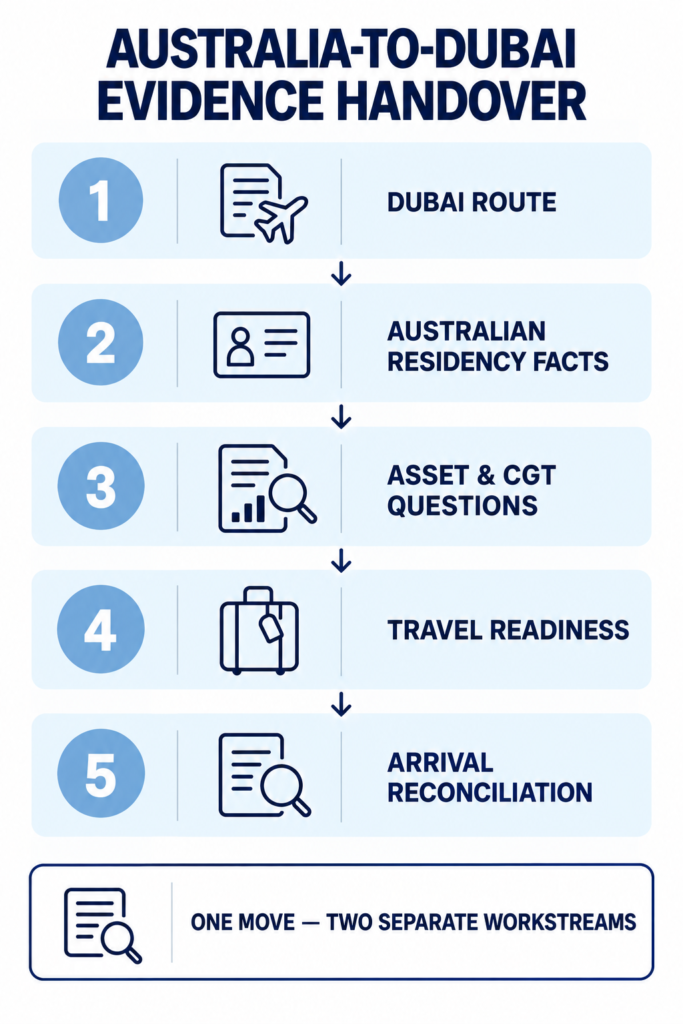
Moving from Australia to Dubai requires more than matching a UAE residence route to a departure date. The Australian tax-residency position, possible asset consequences, travel readiness and continuing Australian arrangements must be reviewed on their own facts, while the Dubai company or property route follows its own authority process.
This guide organises those workstreams for business owners and property buyers. It does not decide your Australian tax status, calculate capital gains tax or promise a UAE approval date. Use it to prepare evidence and questions for the relevant authorities and qualified advisers.
In this guide, you will learn:
- how to identify the Dubai route without turning it into an Australian tax conclusion;
- which Australian tax-residency and asset facts to document;
- how to use current travel and consular information; and
- how to manage the move through evidence checkpoints.

Choose the Dubai route without merging the two legal systems
A Dubai company, a qualifying property and an employment arrangement are different starting points. This article is limited to owner-led company or property planning. Identify the commercial reason for the route first, then confirm the current residence service and documents with the competent UAE or Dubai authority.
| Workstream | Question to answer | Where the detail belongs |
|---|---|---|
| Company | What will the business do, where, for whom and under which licence? | Dubai company and residence checklist |
| Jurisdiction | Does the operating model fit the selected mainland or free-zone route? | Free zone versus mainland comparison |
| Property | Can the buyer own the property, and is residence eligibility being tested separately? | Property and residence guide |
| Household | Which principal, dependent, school, health and housing decisions have their own dependencies? | Family relocation checklist |
A UAE residence document does not determine Australian tax residency. Equally, an Australian tax conclusion does not issue a Dubai licence or residence approval. Keep the authority, question, evidence and decision date in separate columns.
Prepare an Australian tax-residency fact pack
The Australian Taxation Office explains that tax residency is not the same as citizenship or immigration status. Its guidance uses the person’s circumstances and residency tests, and it recognises that a person may be an Australian resident for only part of an income year. The article cannot apply those tests to an individual.
Before seeking advice, build a chronology. Record the intended and actual departure dates, length and purpose of the move, available homes, household location, work and company-management arrangements, visits back to Australia, and ongoing Australian income and assets. Save the documents that support those facts rather than writing only an intended outcome.
| Fact group | Record | Adviser question |
|---|---|---|
| Dates and purpose | Travel, accommodation and actual settlement timeline | Which period and facts are relevant to the residency analysis? |
| Household and homes | Where household members live and what accommodation remains available | How do the continuing arrangements affect the applicable tests? |
| Work and business | Employment, directorship, management and service-delivery locations | Which Australian activities or obligations continue? |
| Income and filings | Australian and overseas income, prior returns and expected changes | Is part-year treatment or another reporting approach relevant? |
Do not write “tax resident until the flight” or “non-resident from the UAE visa date” into the operating plan. Use a provisional date only as a planning input, label it unresolved and update dependent tasks after professional advice or the relevant filing position is confirmed.
Add an asset and CGT-change checkpoint
ATO guidance on ceasing Australian residence explains that capital gains tax consequences may arise for certain assets, while taxable Australian property and available choices can change how an asset is treated. This is not a rule that every asset is taxed on departure or that leaving Australia removes all future Australian tax exposure.
Create an asset register for review. Include the owner, asset type, acquisition records, current supporting documents, intended holding or disposal plan and whether advice is still required. If a contemporaneous value may be relevant, ask the adviser what evidence and valuation date to retain before commissioning work.
- Separate taxable Australian property from other asset categories only after obtaining advice.
- Ask whether a deemed disposal or choice is relevant; do not select an election from a summary.
- Record future events that may reopen the analysis, including disposal or a return to Australian residency.
- Keep tax documentation separate from the Dubai investment or company budget.
The ATO material used for this planning guide must be rechecked before a return, election or transaction. A publication date or example in an older guide is not a substitute for the legislation, current ATO guidance and advice applying to the relevant income year.
Keep Australian accounts, income and notifications visible
An overseas move can leave Australian income, accounts, insurance, companies, superannuation or property arrangements in place. List each provider or payer and ask what address, residency, identity or tax information it requires. Do not infer the tax treatment from whether an account remains open.
For a new Dubai company account, the bank will conduct its own review of the UAE entity, owners, signatories, business purpose and expected transactions. Prepare that separately using the Dubai business bank account checklist. Do not schedule payroll, supplier payments or a property completion around an assumed opening date.
Use current travel and consular information
DFAT’s Smartraveller service publishes current travel advice for the UAE and explains the limits of consular assistance. Conditions and entry information can change, so check the live page before each trip rather than carrying one screenshot through the whole relocation. Consular services do not replace local legal, medical, immigration or commercial advice.
| Before travel | During the move | Keep as evidence |
|---|---|---|
| Read current UAE advice and entry information | Monitor changes before re-entry or family travel | Date checked and the official page used |
| Confirm passport and recipient-specific document requirements | Keep originals and secure digital copies accessible | Document register and recipient response |
| Record insurer and emergency contacts | Use the actual policy terms and local emergency routes | Policy evidence and contact details |
| Understand consular-service limits | Contact the appropriate local authority or professional for case decisions | Authority name, request and response |
Run the move through three decision gates
| Gate | Australian evidence | Dubai evidence | Do not assume |
|---|---|---|---|
| Route gate | Residency chronology and adviser question list started | Named company or property route and responsible authority | A package or purchase automatically produces residence |
| Commitment gate | Asset and continuing-arrangement questions identified | Current status, recipient checklist and fallback | A proposed date is an approval date |
| Reconciliation gate | Actual departure facts and changed ties recorded | Receipts, issued documents and open requests recorded | The original plan still matches what happened |
Give every unresolved item one owner and one next piece of evidence. If the applicant, activity, property, family sequence or departure date changes, reopen every conclusion that used the old facts. A disciplined change log is more useful than an ambitious fixed schedule.
Frequently asked questions
Does Dubai residence end Australian tax residency?
Not automatically. Australian tax residency is assessed under Australian rules and facts. A UAE immigration status is one separate part of the overall record.
Are all Australian assets subject to CGT when I leave?
No single treatment applies to every asset or person. ATO guidance distinguishes asset categories and describes possible consequences and choices. Obtain advice before treating any item as included or excluded.
Can an article give me a safe move date?
No. Use dates as planning checkpoints, then update them using actual authority, adviser, household and business evidence.
Planning an Australia-to-Dubai move?
DRI provides an initial planning discussion for business owners and property buyers. We can help structure the Dubai-side route and its dependencies. Australian tax conclusions, travel decisions and authority approvals remain with the relevant institutions and qualified advisers.
Official sources checked on 15 September 2026: Australian Taxation Office guidance on tax residency, part-year residency and changing residency for CGT, plus DFAT and Smartraveller UAE information. Rules, travel conditions and individual outcomes can change. Confirm the current position with the ATO, relevant providers and appropriately qualified Australian and UAE advisers.