
UAE VAT registration should begin with an evidence test, not with a company-formation date or a copied threshold. The Federal Tax Authority distinguishes mandatory, voluntary and non-resident situations, and the supporting documents vary by legal form and application facts.
This checklist helps a founder prepare an EmaraTax submission. It does not decide whether a particular supply is taxable, determine the registration date, calculate VAT or replace advice from the FTA or a qualified tax professional.
In this guide, you will learn:
- how to separate the mandatory, voluntary and non-resident tests;
- which entity, authority and turnover records to assemble;
- how to review an EmaraTax application before submission; and
- what to hand over after a VAT registration decision.

Start with the correct registration test
The FTA currently states that a UAE resident business is generally required to register when taxable supplies and imports exceeded AED 375,000 over the previous 12 months or are expected to exceed that amount in the next 30 days. It also publishes an AED 187,500 voluntary threshold. Non-resident businesses have a separate test and should not apply the resident thresholds without reviewing the FTA’s current conditions.
| Possible route | Evidence question | Do not assume |
|---|---|---|
| Mandatory registration | What qualifying supplies and imports occurred in the prior 12 months or are expected in the next 30 days? | Company formation alone creates the obligation. |
| Voluntary registration | Do the current FTA eligibility conditions and threshold apply to the entity’s facts? | Voluntary registration is automatically advantageous or approved. |
| Non-resident review | Which UAE supplies are made, and is another person responsible for accounting for the tax? | The resident threshold applies in the same way. |
The FTA also states that a person required to register should apply within the published period after the obligation arises. Because the triggering date depends on the underlying supplies and evidence, do not set the date from a generic incorporation calendar. Record the calculation and obtain advice where the classification is uncertain.
Build a turnover and supply evidence schedule
Prepare a monthly schedule covering invoices, credit notes, imports, relevant expenses and expected near-term contracts. Keep source documents attached to each material amount. The schedule should show what was included, what was excluded, why, who reviewed it and which dates were used.
- Separate actual transactions from forecasts and signed contracts.
- Use consistent legal names, currencies and dates across invoices and ledgers.
- Flag supplies whose VAT treatment is unresolved instead of forcing them into a total.
- Preserve the calculation version used to identify the proposed registration date.
Match the application to the legal entity
The VAT applicant must match the entity shown in the licence, incorporation records and supporting evidence. Confirm the legal name, trade name, legal form, licence number, issuing authority, establishment date, registered address, branches, ownership and authorised signatory. If the real activity is not yet aligned with the licence scope, resolve that issue before presenting an inconsistent tax application. The business-activity guide explains the licensing questions.
VAT registration is distinct from Corporate Tax and the qualifying-free-zone-person analysis. Use the free-zone Corporate Tax questions for that separate workstream.
Prepare the document pack by applicant type
The FTA’s current service page lists documents by legal form and circumstance. A typical preparation file may include the trade licence, incorporation or partnership documents, owner and signatory identification, proof of authority, turnover declaration, financial evidence and bank details. That is not a universal list: use the FTA’s current category for the applicant and any request shown in EmaraTax.
| Evidence pack | Consistency check | Typical owner |
|---|---|---|
| Entity | Names, licence, legal form and branches agree | Founder or company secretary |
| Ownership and authority | Owners, manager and signatory match the corporate records | Founder and authorised signatory |
| Turnover and supplies | Totals reconcile to invoices, ledger and forecast evidence | Finance lead or accountant |
| Contact and bank | Email, telephone, address and account belong to the right applicant | Authorised applicant |
Submit through EmaraTax without losing the evidence trail
The FTA directs applicants to create or use an EmaraTax profile and select the VAT registration service. Before submission, export or record the final answers, calculation, attachments and signatory approval. Save the submission acknowledgement and every later request with its response date and supporting file.
An application is not the same as approval. Avoid issuing a TRN before the FTA provides one, and do not represent a proposed effective date as confirmed. If the FTA asks for clarification, respond from the same evidence schedule rather than creating a conflicting second version.
Run a five-part submission review
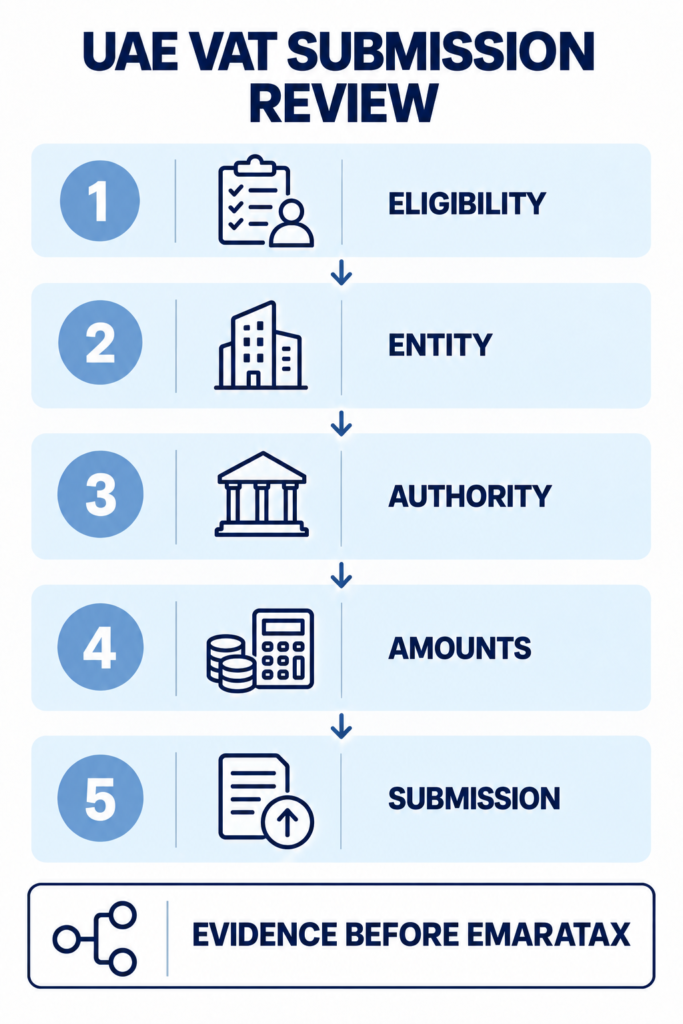
| Review | Question | Completion evidence |
|---|---|---|
| Eligibility | Is the chosen mandatory, voluntary or non-resident route supported? | Dated calculation and advice note where needed |
| Entity | Do licence, legal form, owners and branches agree? | Current corporate documents |
| Authority | Can the applicant and signatory act for the entity? | ID and authority record |
| Amounts | Can every material amount be traced? | Invoice, ledger and forecast schedule |
| Submission | Can the final answers and attachments be reconstructed? | Application copy and acknowledgement |
Plan the post-decision handover
If registration is approved, record the TRN, effective date, certificate, tax-period information and responsible people exactly as issued. Then update invoicing, accounting, contract, bank and filing workflows under qualified supervision. If the application is rejected or returned, preserve the reason and resolve the evidence gap before resubmitting.
Keep the VAT file connected to, but separate from, company formation and banking. The company setup guide covers formation dependencies, while the business-bank guide covers bank onboarding evidence.
Frequently asked questions
Does every new UAE company need VAT registration?
No. Formation and VAT registration are separate. Apply the FTA’s current mandatory, voluntary or non-resident rules to the entity’s actual facts.
Is the mandatory threshold always AED 375,000?
The FTA currently publishes that threshold for the resident-business test, but non-residents and specific situations require separate review. Confirm the current rule and what counts toward it.
Does submitting the form guarantee a TRN?
No. Submission begins the authority review. The FTA may request more information, approve, return or reject an application according to the current process.
Need to organise a founder evidence pack?
DRI can help align the Dubai company setup, activity and banking workstreams. VAT eligibility, classifications, dates and filings should be confirmed with the FTA and a qualified tax adviser.
Official source checked on 17 September 2026: Federal Tax Authority VAT Registration service and registration guidance. Thresholds, documents, procedures and individual outcomes can change; confirm the current FTA position before filing.