
A UAE free-zone licence does not make every dirham of company income automatically subject to a 0% Corporate Tax rate. The result depends on the legal person, the Qualifying Free Zone Person requirements, the nature of each income stream, counterparties, activities, substance, elections and compliance records.
This guide is a pre-structure question set. It does not determine whether a company is a Qualifying Free Zone Person, classify a transaction as Qualifying Income, calculate tax or recommend an election. Those conclusions require the current legislation, Federal Tax Authority guidance and advice based on the company’s facts.
In this guide, you will learn:
- why free-zone status and the QFZP regime are different questions;
- how to create an income-flow map before choosing a structure;
- which substance, transfer-pricing, audit and record questions to raise; and
- how to treat the de minimis rule as a monitoring trigger rather than a shortcut.

Separate the free-zone licence from the Corporate Tax conclusion
The UAE Ministry of Finance explains that free-zone entities remain within the Corporate Tax system. The 0% treatment is available to a Qualifying Free Zone Person for Qualifying Income when the relevant conditions are met. An address, licence or marketing description by itself is not a tax conclusion.
| Question | What it establishes | What it does not establish |
|---|---|---|
| Is the entity established or registered in a Free Zone? | A starting fact for the Free Zone Person analysis | QFZP status or 0% for every income stream |
| Does the entity meet all QFZP conditions? | A legal and factual assessment for the Tax Period | That every receipt is Qualifying Income |
| How is each transaction classified? | The treatment of that income under current rules | A permanent result for changed facts |
| Are compliance requirements met? | Evidence supporting the position | Relief from registration, returns or records unless specifically provided |
Use the free zone versus mainland guide for the operating-jurisdiction decision. This page addresses the tax questions that must be added to that decision; it does not repeat the market-access, premises or residence comparison.
Create an income-flow map before asking about a rate
The FTA’s Free Zone Persons guide connects the regime to the entity, transactions, counterparties, activities and income categories. A total revenue forecast cannot answer those questions. Map each material flow from the commercial event to the contracting party, delivery, invoice, payment and related costs.
| Income-flow field | Fact to record | Question for the tax adviser |
|---|---|---|
| Product or service | What is supplied and which licensed activity supports it | Which activity and income category must be tested? |
| Contracting party | Legal name, location, tax status and relationship | How does the counterparty affect the analysis? |
| Delivery | Where people, assets, premises and systems perform the work | Which location and substance facts matter? |
| Payment | Payer, currency, account and commercial purpose | Does the receipt follow the contract and invoice classification? |
| Related costs | Direct and shared costs, assets and people supporting the flow | What allocation and documentation are required? |
Create a separate row for each materially different customer, transaction route or activity. “Foreign customers” is not one tax category, and receiving money into a free-zone company account does not decide whether the income qualifies.
Test all QFZP conditions as a connected set
The FTA guide describes several requirements for a Qualifying Free Zone Person, including adequate substance, Qualifying Income, transfer-pricing compliance, audited financial statements and the absence of an election to be subject to the standard Corporate Tax regime. The full current list and definitions must be applied together.
- Entity: is the person within the relevant Free Zone Person definition?
- Election: has the entity made, or is it considering, an election that changes the regime?
- Substance: what core income-generating activities, assets, expenditure and qualified employees exist?
- Income: how is each stream tested under the current Qualifying Income rules?
- Related parties: which transactions require arm’s-length and transfer-pricing analysis?
- Financial statements: what audit and accounting records are required for the period?
Do not treat company size as a reason to skip a condition. The FTA guide states that a QFZP must prepare and maintain audited financial statements regardless of revenue. Confirm the current requirement, applicable accounting basis, auditor and timing before relying on a low-cost formation quote.
Use the activity brief as a tax input, not a tax answer
The licence activity should match the real business, but a licence label does not classify every transaction for Corporate Tax. First complete the factual exercise in our Dubai business activity guide. Then give the tax adviser the activity response, actual contracts, counterparties and delivery model.
If the company adds a revenue stream, changes customer types, delivers through another jurisdiction, acquires intellectual property or real property, creates a permanent presence elsewhere, or begins related-party transactions, reopen the tax analysis. The original setup memo should not be reused as a permanent 0% certificate.
Treat de minimis as a monitored calculation
The FTA guide describes a de minimis requirement under which non-qualifying revenue must not exceed the lower of 5% of total revenue or AED 5 million. That published threshold does not tell a company which receipts are non-qualifying, how exclusions apply or whether the underlying records are correct.
| Control | Record | Review trigger |
|---|---|---|
| Revenue classification | Transaction-level category and rationale | New customer, activity, asset or delivery route |
| Total and non-qualifying revenue | Reconciled ledger totals under adviser-approved treatment | Actual results differ from forecast |
| Threshold calculation | Current rule, inputs, period and reviewer | Amount approaches an internal warning level |
| Consequence analysis | Written advice on the facts and current law | Possible breach or classification uncertainty |
The FTA guide explains that failing the de minimis requirement can affect the current Tax Period and the subsequent four Tax Periods. Because the consequence is significant and fact-sensitive, use an internal early-warning process rather than treating “below 5%” as a safe slogan.
Prepare substance and transfer-pricing evidence early
A structure chart and lease do not, by themselves, prove adequate substance. Record who performs the core income-generating activities, where the work occurs, the assets and premises used, operating expenditure, decision-making and any outsourcing arrangement. Connect each fact to a document and accounting record.
For related-party or connected-person dealings, document the commercial arrangement, parties, functions, assets, risks and pricing basis. The FTA guide requires QFZPs to comply with the arm’s-length principle and applicable transfer-pricing documentation rules. Do not assume an owner-managed or small business is automatically outside every requirement.
Run registration, returns and records as a separate workstream
Tax registration, return filing, financial statements, supporting records and payment are compliance tasks distinct from the formation and immigration process. The FTA guide describes a general return deadline linked to the end of the relevant Tax Period, but this article should not assign a deadline without confirming the entity’s registration, period and current requirements.
| Workstream | Owner | Evidence | Open question |
|---|---|---|---|
| Registration | Company and appointed tax adviser | FTA record and effective details | What applies to this entity and period? |
| Accounting | Finance owner | Ledger, contracts, invoices and allocations | Can every material income flow be reconciled? |
| Audit | Management and auditor | Engagement, financial statements and report | What scope and timing are required? |
| Tax return | Authorised filer | Filed return, calculations and supporting memo | Which positions require review or disclosure? |
| Change control | Management | Activity, customer, ownership and structure log | Which change triggers a new analysis? |
Use a pre-structure adviser question sheet
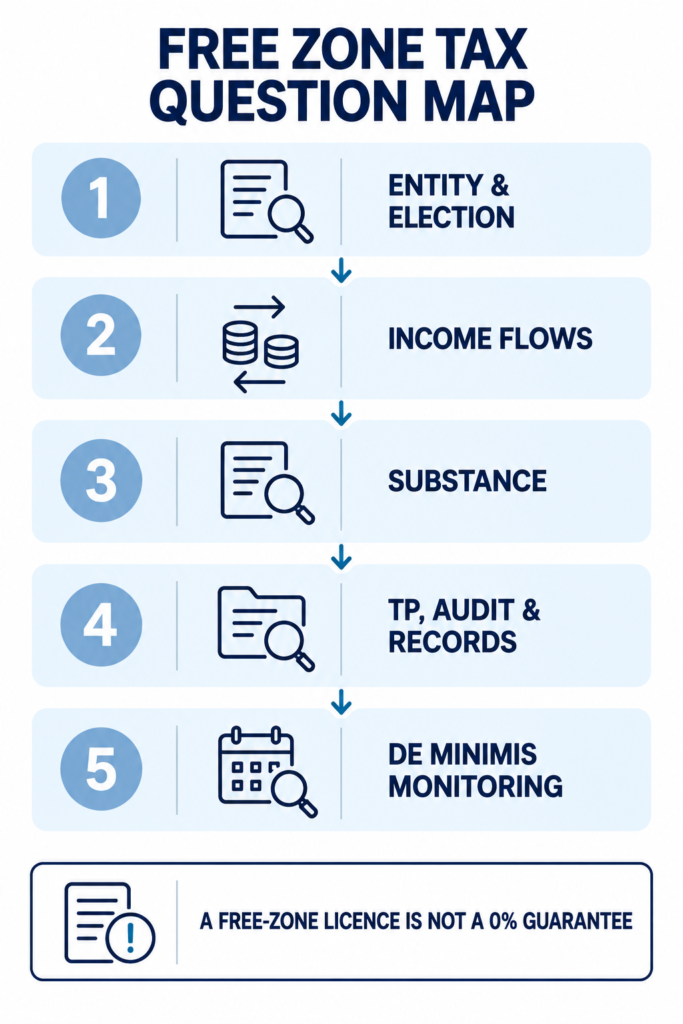
- Is the proposed entity within the Free Zone Person definition?
- Which QFZP requirements require evidence before operations begin?
- How should each planned income stream and counterparty be classified?
- Do any planned activities, assets or locations create an excluded or additional issue?
- What substance, transfer-pricing, accounting and audit records must be built from day one?
- How will actual revenue be monitored against the current de minimis rule?
- Which changes require the adviser memo to be refreshed?
Use the answers in the structure decision, formation budget and operating calendar. A lower setup quote is not lower total cost if the entity cannot support its planned transactions or compliance obligations.
Frequently asked questions
Does every UAE free-zone company pay 0% Corporate Tax?
No. The 0% treatment is tied to a Qualifying Free Zone Person’s Qualifying Income and the applicable conditions. A free-zone licence alone is not enough.
Can I decide whether income qualifies from the customer’s country?
No. Customer location alone does not decide the classification. The entity, counterparty, activity, transaction and current rules must be reviewed together.
Is the 5% de minimis threshold a safe allowance?
It is a condition with defined inputs and consequences, not permission to guess the classification. Use reconciled records and current professional advice.
Comparing a free-zone structure for a Dubai business?
DRI provides an initial discussion to organise the activity, jurisdiction, formation and relocation questions. Corporate Tax classification, QFZP eligibility, filings and tax advice remain with the FTA and appropriately qualified tax professionals.
Official sources checked on 15 September 2026: UAE Ministry of Finance Corporate Tax information and the Federal Tax Authority Free Zone Persons Corporate Tax Guide. The guide version reviewed was dated 20 May 2024 and must be checked for later amendments, decisions and guidance before a structure or filing decision. This article is general information, not tax advice.