
Moving to Dubai from the UK through a Dubai company or a qualifying property investment is not a single visa transaction. It is a coordinated move across UK departure administration, UAE residence eligibility, documents, health cover and a realistic arrival plan.
This guide is for business owners and property buyers. It does not cover an employment-sponsored move or a freelance route. A visit permission, company licence or property purchase should never be treated as automatic proof that a residence application will be approved.
In this guide, you will learn:
- how to choose and verify your company or property route before leaving the UK;
- which UK tasks belong to your own tax and document position;
- how to sequence residence, insurance, banking and household arrangements; and
- how to keep family arrangements workable when a document or approval takes longer than expected.

Start with the route, not the flight date
Your right to visit, live and operate a business are different questions. British citizens should check the current UAE entry requirements before travel; that page distinguishes visitor entry from the permissions needed to live or work. For an owner-led move, identify the intended residence route first, then check its eligibility with the competent Dubai or UAE authority.
| Route | What to establish separately |
|---|---|
| Dubai company | Activity, jurisdiction, licence, then the applicable owner/partner residence application |
| Dubai property | Ownership eligibility, property evidence, and the precise property-owner or Golden Residence route |
For a mainland company, the UAE Ministry of Economy & Tourism describes a sequence of business activity, legal form, trade name, initial approval, documents, premises, approvals and licence issuance. Initial approval is not permission to operate. Read the official mainland setup overview.
If you are considering property, keep buying and residence eligibility separate. Dubai Land Department and GDRFA Dubai publish distinct property-related services. Their currently published rules can differ from federal summaries on duration and mortgage treatment, so confirm the route that applies to your property and application facts before committing funds. See our property-residency route guide for the detailed distinction, and the current DLD, GDRFA Dubai, and ICP service pages for authority-specific wording.
For a company route, make a written decision record before engaging a formation provider: the activity you will actually carry out, where customers are located, whether you need premises, the ownership and governance position, and the residence route you intend to investigate. A mainland and a free-zone company are not interchangeable labels. Dubai’s own business-setup information distinguishes the jurisdictions and their trading permissions, while activity-specific rules can add approvals. The company decision should therefore be tested against commercial operations as well as relocation aims. Continue with the company setup and residency checklist and the free zone versus mainland comparison.
For a property route, first ask whether the purchase makes commercial and household sense independently of residence. Then ask the competent authority which service card applies, what ownership and valuation evidence is needed, and how a mortgage affects the application. This order prevents a buyer from treating an estate-agent summary or a general Golden Visa headline as a personalised eligibility decision.
Complete the UK departure workstream on its own facts
Do not assume that a UAE residence permit decides your UK tax position. HMRC says the method for telling it that you have left depends on whether you normally complete Self Assessment: people who do not normally file may use P85, while Self Assessment filers use the residence section and SA109. UK residence and split-year treatment depend on the individual facts. Check HMRC’s leaving-the-UK guidance and take regulated UK tax advice where required.
Make a document list early. Birth, marriage and company documents may need legalisation or attestation, but the receiving authority or school must confirm what it accepts. The UK Legalisation Office advises applicants to contact the person requesting the document, and the UAE Ministry of Foreign Affairs directs overseas-issued documents through the relevant UAE Mission. UK document legalisation guidance · UAE document attestation guidance.
Keep the UK and UAE workstreams distinct in your notes. One list should cover HMRC, banking, insurance and any UK advisers who need to know your departure date. A second list should cover the UAE authority, formation agent or property service, the evidence it has requested, and the expiry date of each certificate. Joining the lists only at milestones helps prevent a delayed UAE document from being mistaken for a conclusion about UK tax residence, or vice versa.
Plan health cover and documents before settling housing
The UAE has no reciprocal healthcare agreement with the UK. GOV.UK recommends appropriate health insurance for healthcare costs, so treat cover as an arrival requirement to organise alongside, rather than after, your residence planning. Read GOV.UK’s UAE healthcare guidance.
- Keep passports, certified civil records and company papers in a document tracker.
- Ask each receiving party which format, attestation and translation it requires before ordering work.
- Use temporary accommodation until the residence and practical requirements needed for a long lease are clearer.
- Keep a contingency budget for insurance, deposits, document work, school applications and a longer transition period.
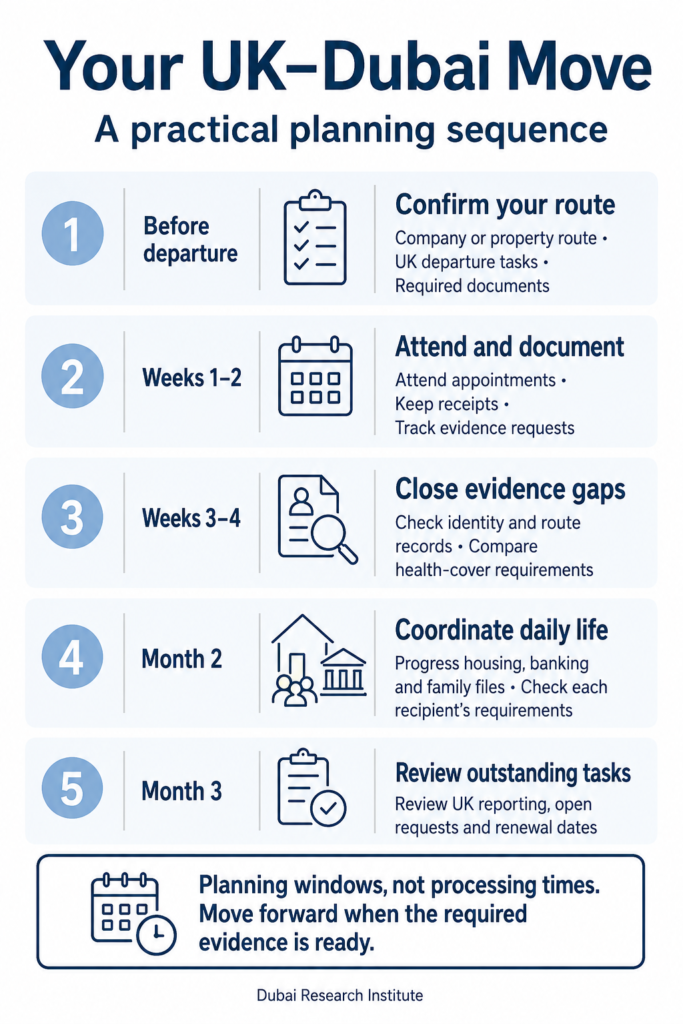
Build a realistic first-90-day sequence
Begin with the route-specific application and documents. Then schedule the practical tasks that depend on your status and identity documents: insurance, local banking enquiries, longer-term housing and family arrangements. Exact ordering differs by route and provider, so a checklist is a planning tool rather than an approval guarantee.
The following 90-day framework uses editorial planning windows, not published authority processing times. Move a task only when its dependency is evidenced. A date in the plan means “review or act by this date”; it does not predict when an authority, bank, school or insurer will decide.
| Planning window | Task and evidence | Dependency before commitment |
|---|---|---|
| Before departure | Name route; save checklist and case-specific response. | Keep UK commitments reversible. |
| Weeks 1–2 | Attend appointments; retain receipts and evidence requests. | Use the status actually held. |
| Weeks 3–4 | Reconcile identity and route records; compare health-cover requirements. | Correct evidence gaps before reuse. |
| Month 2 | Progress housing, banking and dependent files. | Check recipient onboarding lists. |
| Month 3 | Review UK reporting, open requests and renewal dates. | Keep UK and UAE conclusions separate. |
Turn the framework into a weekly control sheet. Give every row one owner, one next action and one piece of completion evidence. “Visa being handled” is not evidence; a named service, a dated submission receipt or a written request is. “Bank account under way” is not a dependency you can safely use for payroll; record the bank’s requested documents and a fallback for payments instead.
For each short table entry, keep the detail in an attached action row: recipient, exact request, evidence received, due date, dependency, fallback and the date the information was last checked.
Close an action only when the evidence is stored and the next dependent task has been updated. If the answer arrives by telephone, write the caller, date and question, then ask whether written confirmation is available. If no written confirmation is provided, label the note as an enquiry record rather than an authority decision.
Use a recipient-based document tracker
A single label such as “attested documents” hides the question that matters: who will receive each document and what will that recipient accept? GOV.UK tells applicants to check with the person requesting legalisation, while UAE MOFA describes the attestation path for documents issued outside the UAE. Record the recipient’s answer beside the item rather than applying one format to the whole family file. Check the UK legalisation service and UAE MOFA’s attestation service.
| Recipient and purpose | Track before ordering work | Completion evidence |
|---|---|---|
| Licensing authority: owner or shareholder record | Exact document, issuing country, accepted copy/original and translation language | Written checklist plus final accepted file |
| Immigration service: principal or dependent application | Route name, applicant name and date-sensitive requirements | Submission receipt or authority acknowledgement |
| School: age/year placement | Academic record, translation and authentication requested by that school | Admissions team confirmation and file version |
| Bank or insurer: onboarding | Identity, address, business or policy evidence requested by the provider | Provider acknowledgement; do not assume immigration acceptance is enough |
Add columns for document owner, exact name shown, issue date, expiry date, original location, digital filename, translation status and the person who confirmed acceptance. If two recipients want the same civil record in different forms, create two requirement rows. This prevents an accepted school copy from being mistaken for an immigration-ready document.
Illustrative household sequence
Illustrative example, not a DRI client result: a UK company owner plans to move first, while their partner and one school-age child remain in the UK temporarily. The owner’s company activity and intended residence category are documented before flights are booked. The household keeps its UK home and school place through the first review point. During the owner’s first weeks in Dubai, a request arrives for a revised corporate document. The owner updates the company file while the partner continues school enquiries and obtains recipient-specific instructions for the child’s records. No one treats the additional request as a refused application or as proof of an approval date.
At the end of month one, the family reviews evidence rather than optimism: the principal’s current status, the exact dependent checklist, available school places, health-cover start conditions and a workable commute from temporary housing. If one dependency remains open, the partner and child travel later. If it is resolved, the family can progress dependent applications and housing without relying on the company incorporation date as the household move date. The useful lesson is the decision gate: retain a reversible arrangement until the document needed for the next commitment is actually available.
Use the same discipline for UK departure administration. Keep a departure evidence folder with the travel date used for planning, UK accommodation changes, employment or company-management changes, adviser notes and the HMRC route you have been told applies. Do not copy a Dubai approval date into the UK tax column as though it decided residence. If the intended departure date moves, flag every UK task that used the old date and ask the relevant adviser or organisation whether the change matters.
- Weekly review: which next commitment has evidence, which is still conditional, and who owns the next request?
- Month-end review: which temporary arrangement can safely close, and which must remain available?
- Change review: if the route, applicant, property, activity or family travel order changes, which recipient checklists must be refreshed?
If an authority requests additional evidence, preserve flexibility. Do not give notice on UK housing, arrange a long lease or move school-age children solely because a company application has been submitted. A phased arrival can make it easier to resolve documents, housing and school placement without forcing the household into a fixed deadline. If a partner or children are joining later, use the family relocation checklist to plan their separate workstream.
Before each commitment, ask what must be true for the next step to work. A bank may have its own onboarding requirements. A landlord may require documents different from those used for immigration. Schools and insurers may work to their own lead times. Recording the owner, evidence and deadline for every dependency makes gaps visible while they can still be resolved from the UK.
Coordinate your move with a Dubai relocation plan
DRI can help you organise the decisions and questions around a company-formation or property-led relocation. See relocation support for the areas to prepare before you make commitments.
Sources checked 7 September 2026: GOV.UK entry requirements, HMRC leaving the UK, GOV.UK living in the UAE, GOV.UK legalisation, UAE MOFA attestation, and UAE Ministry of Economy & Tourism.