
Selling a completed property in Dubai requires more than signing a buyer agreement. The seller must keep the property status, developer e-NOC, settlement evidence and Dubai Land Department transfer aligned so that the ownership record changes through the correct channel.
This guide focuses on an individual seller of a completed freehold property. Mortgaged property, off-plan assignments, corporate ownership, inheritance and court-related transfers can follow different requirements and should be checked with the relevant developer, DLD service and qualified advisers.
In this guide, you will learn:
- how to identify the correct sale and ownership type;
- what to organise before requesting the developer e-NOC;
- how to prepare the DLD Trustee transfer pack; and
- which records to retain after the new title is issued.

Confirm that this is a completed-property sale
DLD’s Property Sale Registration service covers the sale of completed land, property and units. Do not use its checklist unchanged for an off-plan assignment, a sale with an active mortgage, a gift, inheritance or another transaction type. Identify the title holder, property type, developer, mortgage status, buyer type and any representative before fixing the transfer route.
| Fact | Evidence | If unresolved |
|---|---|---|
| Registered owner | Current DLD title document and identity | Verify the record before marketing or signing |
| Completed status | Property and developer records | Use the correct off-plan or other service |
| Mortgage or restriction | Bank and DLD information | Confirm the separate settlement and transfer route |
| Authority to sign | Owner attendance or accepted POA | Resolve representation before the transfer appointment |
Buyers have their own readiness workstream. Direct them to the ready and resale buying guide; keep this page focused on the seller’s evidence and handover.
Set the seller evidence file before the e-NOC request
Before asking the developer for an e-NOC, reconcile the owner name, unit details, title information, service-charge position, buyer agreement and any settlement dependencies. The developer controls its own clearance process and may request property-specific evidence. Do not publish a fixed NOC fee, validity period or turnaround time unless it has been confirmed for that developer and transaction.
- Keep the current title document and owner identification together.
- Record the buyer, agreed price, deposit and contractual milestones.
- Resolve developer account and property-management balances requested for clearance.
- Identify any bank, tenant, representative or corporate document that changes the normal path.
Treat the developer e-NOC and DLD registration as different controls
DLD’s current service page lists the developer’s electronic no-objection certificate among the documents for an individual freehold sale. The e-NOC is developer-side evidence; it is not the ownership transfer itself. The DLD registration is the authority process that changes the registered ownership record.
Save the request, supporting documents, payment evidence, issue date, stated validity and any conditions exactly as provided. If a detail in the agreement changes after the NOC is issued, ask whether a new or amended clearance is required rather than assuming the first NOC remains usable.
Prepare the seller, buyer and representative documents
DLD lists Emirates ID for the parties and a valid passport for a non-resident foreigner among the individual-document requirements. The exact pack depends on who is attending, the ownership form and the transaction. A representative must have authority that is accepted for the intended act; the overseas property POA checklist covers that separate preparation.
| Party | Core evidence to organise | Transaction-specific check |
|---|---|---|
| Seller | Identity, title and developer clearance | Mortgage, tenant, joint owner or representative |
| Buyer | Identity and agreed settlement evidence | Finance approval or representative authority |
| Representative | Identity and accepted POA | Exact sale, receipt and signing powers |
| Entity, if involved | Licence, incorporation, ownership and authority records | Current DLD and developer requirements |
Separate settlement planning from the transfer appointment
Agree how the price, deposit, outstanding loan, fees and other balances will be evidenced without assuming one party always pays a particular item. The DLD service page publishes current registration and service-partner fees, but commercial allocation can depend on the agreement and transaction. The DLD fees guide explains buyer-side cost categories without replacing a seller settlement statement.
Create a settlement sheet naming the payer, payee, amount, instrument, due event, evidence holder and contingency if a payment is rejected. For a mortgaged property, use the relevant bank and DLD procedure rather than inserting a loan payoff into the normal unencumbered-sale checklist.
Use a controlled Trustee transfer sequence
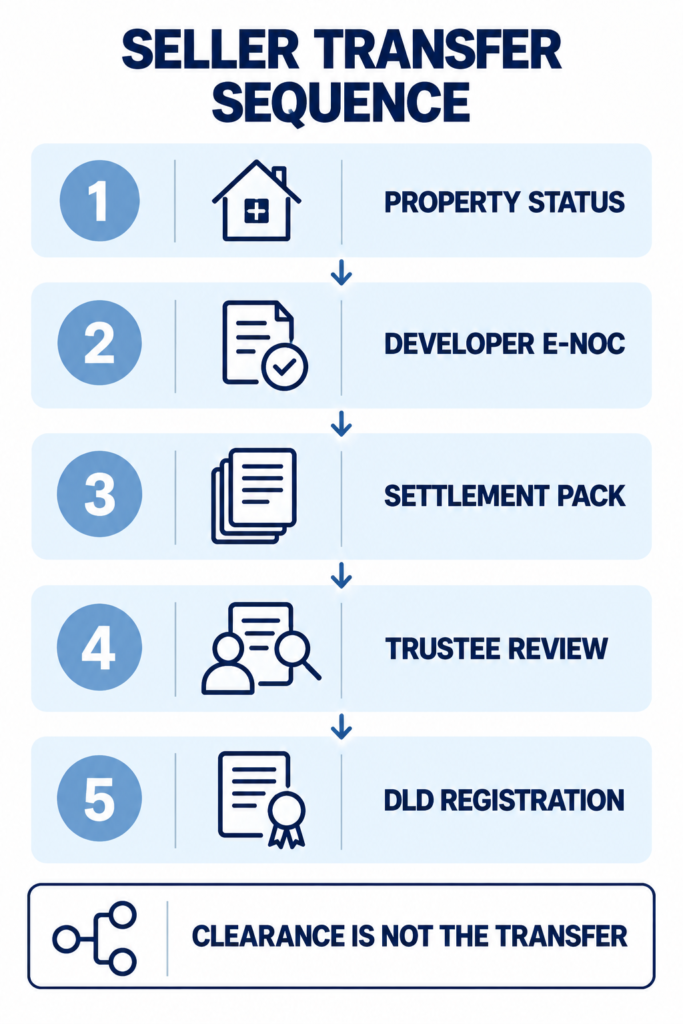
| Stage | Control question | Evidence to retain |
|---|---|---|
| Pre-appointment | Are identity, title, e-NOC, authority and settlement evidence current? | Appointment pack and written checklist |
| Trustee review | Do the transaction data and parties match the documents? | Corrections, payment records and submission reference |
| DLD registration | Has the authority completed the ownership change? | Official transaction output and receipt |
| Handover | Have property, access, utility and stakeholder records been transferred? | Signed handover and closure log |
DLD’s FAQ emphasises that real-estate transactions must be registered. Do not treat a signed agreement, paid deposit or developer NOC as the final registered transfer.
Close the seller file after the new title is issued
After registration, verify the buyer and property details on the authority output. Reconcile the final settlement, release documents, receipts, agent records and keys or access devices. Notify the developer, building management, utility providers and tenant where the transaction requires it. Preserve a complete file for tax, banking and dispute-prevention purposes.
If the property was originally acquired as an investment, keep the sale file separate from purchase due diligence. The broker and project verification guide explains pre-purchase checks.
Frequently asked questions
Is a developer NOC the property transfer?
No. The developer e-NOC is supporting clearance for the applicable transaction. The ownership change is completed through the relevant DLD registration process.
Can a seller use this checklist for a mortgaged property?
Not without modification. A mortgage adds the bank and the DLD mortgaged-sale procedure. Confirm the current route with all involved institutions.
Can a non-resident seller appoint someone to attend?
A duly authorised representative may be possible, but the POA, authentication, scope, validity and acceptance must be confirmed for the transaction.
Preparing to sell a completed Dubai property?
DRI can help organise the seller-side property, developer and transfer questions. Legal authority, finance settlement and final DLD requirements should be confirmed for the specific transaction.
Official sources checked on 17 September 2026: Dubai Land Department Property Sale Registration service and DLD frequently asked questions. Service conditions, fees, documents and individual outcomes can change; confirm the current transaction-specific requirements before acting.