
Selling a Dubai property while the owner is abroad requires a document that does more than name a representative. The power of attorney must be prepared for the intended property act, follow the applicable overseas authentication chain and be accepted by the developer, Trustee and Dubai Land Department process involved.
This checklist focuses on a POA issued outside the UAE for a Dubai property transaction. It is not legal advice, does not draft the instrument and does not guarantee that an owner can complete a sale without attending. Confirm the wording, authentication, translation, validity and acceptance with the relevant authorities and qualified legal professionals.
In this guide, you will learn:
- how to define the representative’s authority narrowly;
- which overseas authentication stages DLD describes;
- how to match the POA to developer and transfer requirements; and
- what to recheck before the final transfer appointment.

Confirm that a POA is necessary and accepted
Begin with the exact transaction and the reason the owner cannot act directly. Ask the developer, registration channel and DLD service whether a representative may perform each intended act and what form of POA is accepted. A POA used to request information may not authorise signing, receipt of funds, mortgage settlement or final transfer.
| Question | Evidence to obtain | Unsafe assumption |
|---|---|---|
| Who is the registered owner? | Current title and identity records | A family relationship proves authority |
| What transaction will occur? | Completed sale, off-plan act, mortgage or other service | One generic POA covers every property act |
| Which channel will receive it? | Developer, Trustee and DLD confirmation | Acceptance by one recipient binds all others |
| Will the owner attend any stage? | Written attendance and signature plan | A POA always removes personal attendance |
Keep the normal seller workflow separate. The seller e-NOC and DLD transfer guide covers the completed-sale sequence; this page covers only the overseas authority layer.
Define the powers by act, property and recipient
DLD’s FAQ states that a legal proxy can act within a duly legalised and regulated POA. “Within” matters. Prepare an authority matrix before drafting: identify the property, owner, representative, transaction, agreements, developer submissions, DLD registration, payment or receipt acts and any mortgage-related steps.
- Name the property and relevant identifiers accurately.
- List the agreements and authority submissions the representative may sign.
- Address payment instruments, receipt of proceeds and handover only after legal and bank review.
- Exclude powers that are not needed instead of relying on a broad template.
A qualified lawyer or notary should prepare or review the final instrument. DRI can help organise the transaction facts, but it should not decide whether a clause creates sufficient legal authority.
Follow the overseas authentication chain described by DLD
For a POA issued outside the UAE, DLD’s FAQ describes a chain involving notarisation in the country of issue, authentication by that country’s foreign-affairs authority, attestation by the UAE embassy and authentication by the UAE Ministry of Foreign Affairs. The exact procedure and document format depend on the issuing country and current receiving requirements.
| Stage | Control | Record |
|---|---|---|
| Draft and signature | Correct owner, representative, property and powers | Approved final text and identity evidence |
| Country of issue | Required notarisation and foreign-affairs authentication | Official stamps, references and dates |
| UAE mission | Required embassy or consular attestation | Attested original and receipt |
| UAE completion | Current MOFA, translation and receiving-channel requirements | Final legalised set and acceptance confirmation |
The chain is not evidence that the wording is sufficient, the document is still valid or a particular representative will be accepted. Check those matters separately before shipping originals or booking a transfer.
Control translation, originals and identity matching
Ask the receiving organisation whether an Arabic legal translation is required, who may produce it and whether the translation must be attached to the legalised original. Names, passport details, property identifiers and signature details should match across the POA, title, agreement and transfer file.
Maintain an original-document register. Record the custodian, courier, tracking number, receipt date, scanned copy and the event for which the original may be surrendered or shown. Do not rely on a scan if the receiving channel requires the legalised original.
Match the POA to the developer and DLD transfer pack
A completed freehold sale may require the developer’s e-NOC and a DLD registration through the applicable channel. Ask each recipient to review or confirm the POA requirement before the owner signs abroad. Record whether the representative may request the NOC, sign the sale documentation, present payment evidence, complete registration and receive official outputs.
Do not use a purchase POA or a general administrative POA as proof of sale authority without review. DLD’s FAQ discusses different purposes and validity considerations; avoid turning those examples into a universal fixed term. Confirm the current rule and the dates relevant to the exact transaction.
Protect the payment and settlement handover
Authority to sign and authority to receive or redirect funds are different risk questions. Document the expected payer, payee, bank account, payment instrument, exchange path, mortgage settlement and evidence holder. Ask the bank, Trustee and legal adviser which acts the representative may perform and which need separate confirmation from the owner.
For a purchase rather than a sale, use the ready and resale guide to understand the underlying transaction. For off-plan property, use the off-plan guide; the registration and developer controls differ.
Use a pre-transfer POA acceptance gate
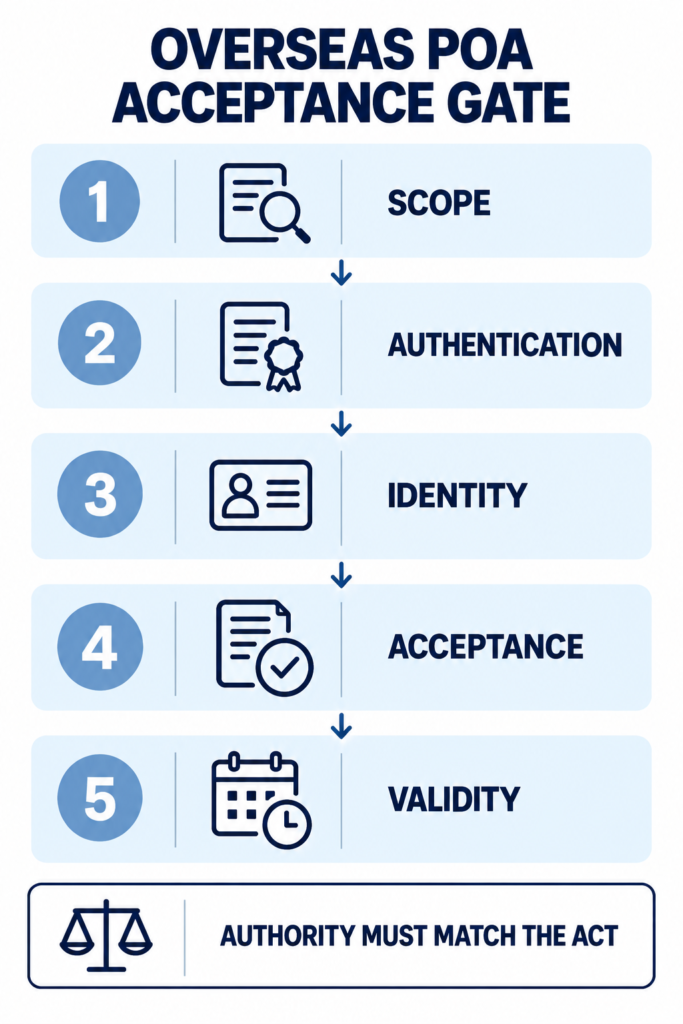
| Gate | Question | Completion evidence |
|---|---|---|
| Scope | Does the POA authorise each necessary act for this property? | Legal review against the transaction matrix |
| Authentication | Is the required country and UAE chain complete? | Legalised original and receipts |
| Identity | Do names, IDs and property details match? | Cross-document reconciliation |
| Acceptance | Have developer, Trustee and DLD requirements been checked? | Current written confirmation or checklist |
| Validity | Is the POA unrevoked and accepted on the intended date? | Final legal and recipient confirmation |
Run the gate again if the buyer, price, property, representative, mortgage or transfer date changes. Do not use an earlier acceptance message as a permanent guarantee.
Frequently asked questions
Is notarisation abroad enough for a Dubai property POA?
Not necessarily. DLD describes additional foreign-affairs, UAE embassy and UAE MOFA stages for a POA issued outside the country. Confirm the current chain for the issuing country.
Can one POA cover every Dubai property transaction?
Do not assume so. The authority must match the property, transaction and acts the representative will perform, and each recipient must accept it.
Does a POA guarantee a fully remote sale?
No. The developer, bank, Trustee or DLD process may impose identity, document or attendance requirements. Confirm the full path before relying on remote completion.
Selling a Dubai property while abroad?
DRI can help map the property, developer and transfer dependencies. The POA wording, legalisation, validity and acceptance should be confirmed by the relevant authorities and qualified legal professionals.
Official source checked on 17 September 2026: Dubai Land Department frequently asked questions and Property Sale Registration service. Authentication, translation, validity and acceptance requirements can change; confirm the current transaction-specific position before signing.