
Dubai property service charges are recurring ownership costs, not part of the one-off Dubai Land Department (DLD) registration fee paid when a property changes hands. Buyers should therefore check them against the exact project, usage and year before comparing homes or estimating a landlord budget.
This guide explains how an international buyer can use the DLD Service Charge Index, title information and current account records to build an annual ownership-cost check. It does not quote a market-wide rate, forecast returns or decide an individual payment dispute.
In this guide, you will learn:
- what service and usage charges are intended to cover;
- how to search the official index without using the wrong project or year;
- which records to request from a seller, developer or management entity; and
- how to place recurring costs beside the purchase budget.

Separate purchase costs from ownership costs
A buyer may encounter DLD registration, title, Trustee, broker, mortgage and other transaction charges around completion. Those amounts answer “What cash is needed to acquire and register the property?” A service charge answers a different question: “What approved annual contribution relates to operating and maintaining a jointly owned property?”
If you are still defining the acquisition route, begin with the Buying Property in Dubai guide. Use the purchase decision to identify the exact unit and records, then build the recurring ownership-cost check described here.
| Cost layer | Timing | Primary check |
|---|---|---|
| Purchase and registration | Reservation, contract, transfer or initial registration. | Current DLD service page, contract and itemised completion statement. |
| Service charge | Recurring during ownership. | DLD Service Charge Index, approved budget and account statement for the exact property. |
| Usage charge | Where applicable to master-project common facilities. | Project documents, DLD information and the current account. |
| Other owner costs | According to the property and operating model. | Insurance, repairs, utilities, management, permits, finance and contract-specific records. |
Use our Dubai property purchase costs and DLD fees guide for the acquisition layer. Keep the service-charge worksheet beside it, but do not merge the two into one unexplained percentage.
What DLD says the charges cover
DLD describes the service charge as a RERA-approved annual amount collected from owners to meet the costs of managing, operating, maintaining and repairing jointly owned property. Its FAQ gives examples that may include security, cleaning, maintenance, utilities, administration, insurance, master-community usage and reserves.
Those are general categories, not a promise that every project invoice contains the same items. DLD also distinguishes a usage charge associated with common facilities in a master project. A buyer should therefore ask which charge applies, how the property’s share is determined and whether the account contains a current balance or arrears.
| Term | Official function | Buyer caution |
|---|---|---|
| Service charge | Annual contribution toward jointly owned property management, operation, maintenance and repair. | Check the exact project, usage, approved year and property allocation. |
| Usage charge | Annual charge associated with common facilities of a master project. | Do not assume it is included in, or always separate from, every service-charge invoice. |
| Reserve component | One of the categories DLD lists among possible joint-service-charge items. | Ask what the approved budget and property records show; do not infer the physical condition of the building from the label alone. |
| Arrears | An amount outstanding on the property account. | The DLD online index states that its service-charge result does not include arrears. |
How to use the DLD Service Charge Index
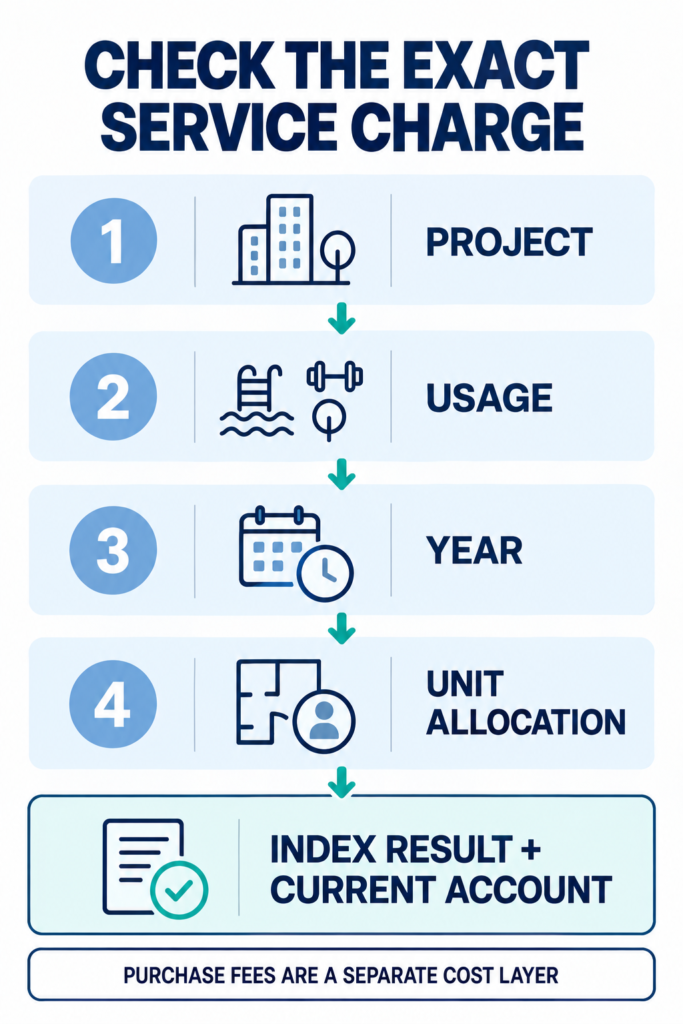
DLD’s Service Charge Index is the official inquiry service for approved service fees in Dubai’s jointly owned properties. Its published procedure asks the user to select the project name, usage and year. Each field matters.
- Open the current DLD Service Charge Index service page rather than relying on an undated screenshot.
- Take the project’s official name and property identifiers from current documents.
- Select the usage that matches the property record, not merely the planned commercial use.
- Select the relevant budget year and record the lookup date.
- Save the result and identify each displayed category and unit basis.
- Compare it with the current approved budget, seller account statement and transaction completion statement.
A nearby building, a similarly branded tower or a previous year is not a substitute. Projects may have different facilities, approved budgets, usage categories and charge structures. If the project cannot be identified with confidence in the index, pause the estimate and ask DLD, the developer or the management entity for the identifiers needed to reconcile the record.
Do not stop at rate × area
DLD’s FAQ explains the common service-charge allocation with reference to the owned area shown on the title deed and the project’s total cost. That is useful for understanding the method, but a buyer still needs the relevant certificate, approved categories and account statement. The area used for a charge may be described differently from a marketing brochure’s headline area.
| Input | Evidence to retain | Common error |
|---|---|---|
| Project | Official project name and property identifiers. | Using a neighbourhood average. |
| Usage | Title or property record plus the selected index category. | Choosing residential or commercial from intended use alone. |
| Year | Selected approved year and lookup date. | Carrying an old rate into a later ownership budget. |
| Area or allocation basis | Title/certificate and current charge document. | Using a sales-brochure area without reconciliation. |
| Account balance | Dated seller/management statement and clearance evidence required for transfer. | Assuming the index result includes arrears. |
| Additional items | Approved budget, invoice and relevant contract. | Assuming every ownership cost appears in the index. |
Use the result as a verified input, not as the entire annual budget. Insurance, private repairs, in-unit utilities, finance, furnishing, leasing or property management, permits and vacancy-related costs may sit elsewhere. Which items apply depends on the unit and intended use.
What to request before buying a ready property
- The latest service-charge account statement for the exact unit.
- The approved project budget or current charge certificate available for review.
- A breakdown of service, usage, reserve and other categories shown.
- The area or share used for the allocation.
- Evidence of payments, credits, arrears or adjustments affecting the account.
- The document or clearance needed for transfer and who will obtain it.
- Any material notice about works or charges supplied through the transaction.
Match every record to the same unit, seller, year and project. Do not interpret an account document as a building-survey conclusion, and do not treat an approved budget as a guarantee of service quality or future investment performance. Follow the ready and resale purchase process for the wider title, seller, agreement and transfer work.
What to check for an off-plan property
An off-plan buyer may not yet have an operating history for the completed building. Ask what the SPA says about service charges, the basis and timing of any estimate, the period beginning at handover, and which records will be available before accepting the unit. Keep any estimate labelled as an estimate until a current approved amount can be checked.
This is separate from checking the developer, project and escrow account before committing. The off-plan purchase checklist covers that earlier transaction work. The service-charge check becomes an ownership-budget gate, not proof that the project will complete on a promised date.
Place the amount in an annual operating worksheet
Create one row for each recurring or contingent cost. For the service-charge row, record the project, year, usage, area basis, displayed categories, annual amount, evidence link and next recheck date. If a property will be rented, keep gross rent separate from owner-paid costs, tenant-paid items, management fees, maintenance and vacancy assumptions.
If you intend a long-term tenancy, our Dubai Rental Index guide for landlords explains the separate rent-review and renewal workflow. If you intend short-term letting, check the Holiday Home permit requirements before treating the unit as available to list. Neither operating route converts an annual cost estimate into a guaranteed yield.
Frequently asked questions
Are service charges the same as DLD purchase fees?
No. Purchase registration charges relate to acquiring and registering the property. Service charges are recurring owner contributions associated with jointly owned property.
Does the DLD index show the owner’s total amount due?
Not by itself. The online result states that service charge does not include arrears. Reconcile the index with a current account statement and the transaction records.
Can I use an average charge for the neighbourhood?
An average may be a rough early assumption, but it does not verify the actual property. Use the official project, usage, year and property allocation before making a commitment.
Comparing the annual cost of a Dubai property?
DRI provides an initial property-planning discussion for international buyers. Share the project or property being considered, intended use, purchase stage and the costs already confirmed. We can help organise the questions for the transaction; official bodies, management entities and qualified advisers remain responsible for their own records and advice.
Official sources checked on 14 September 2026: DLD Service Charge Index, DLD frequently asked questions and the current online index result. Project budgets, categories, account balances and procedures can change. Confirm the exact project, usage, year, property allocation and current account with DLD and the relevant transaction or management parties before buying or paying.