
Dubai’s Rental Index is an official reference used in the rent-review framework, but an index result is not the whole renewal process. A landlord must connect the correct property inputs, the current rent, the statutory band, the tenancy terms and the required notice timing before proposing a change.
This guide is for landlords preparing a long-term residential tenancy review in Dubai. It explains the published index and renewal sequence at a general level. It does not cover Holiday Homes, decide a dispute, advise on eviction, or predict what the Rental Disputes Center or another authority will decide in an individual case.
In this guide, you will learn:
- what the Rental Index contributes to a renewal review;
- how Decree No. 43 of 2013 structures maximum increase bands;
- why eligibility, percentage and notice are separate checks; and
- which evidence to retain before communicating a proposal.

First identify the rental regime
This article concerns a long-term tenancy renewal. Short-term guest accommodation under Dubai’s Holiday Homes regime has a different permission and operating framework. If the proposed use is short-term letting, begin with the Dubai Holiday Home permit guide instead of applying the renewal bands below.
| Question | Long-term tenancy review | Holiday Home operation |
|---|---|---|
| Core official framework | Tenancy law, rent-increase decree, official Rent Index and tenancy records. | DET permit, unit eligibility, classification and operating requirements. |
| Main decision | Whether and how tenancy terms may change at renewal. | Whether the unit may be listed and operated for short stays. |
| Do not substitute | Private asking rents for the official benchmark. | A neighbour’s listing for the exact unit’s permit. |
Also verify that the contract, property and parties fall within the framework being relied upon. A calculator result should not be copied into every property, free-zone or contract scenario without checking scope and current law.
What the official increase bands mean
Dubai Decree No. 43 of 2013 links the maximum increase on renewal to the difference between the existing rent and the average rental value of similar real property. The average value is determined according to the Rent Index approved by the Real Estate Regulatory Agency (RERA).
| Existing annual rent compared with the average rental value | Maximum increase stated in Decree 43/2013 |
|---|---|
| Up to 10% below | 0% |
| 11% to 20% below | 5% |
| 21% to 30% below | 10% |
| 31% to 40% below | 15% |
| More than 40% below | 20% |
These are conditional maxima, not an automatic annual entitlement. A statement such as “Dubai landlords can raise rent by 20%” removes the most important part of the rule: the property must fall into the relevant difference band, and the wider renewal and notice requirements still need to be checked.
Do not calculate the difference using asking prices from a private listing portal and label it the legal band. Market listings can be useful commercial context, but the Decree identifies the RERA-approved Rent Index as the basis for average rental value.
Use a six-step renewal review
- Fix the contract facts: record the parties, exact property, current annual rent, start and expiry dates, amendments and any agreed notice wording.
- Open the current official service: use DLD’s Rental Index or calculator interface and record the lookup date.
- Enter the matching property data: use the official tenancy/property records rather than a marketing description.
- Save the result: retain the inputs and output, not only a percentage copied into a message.
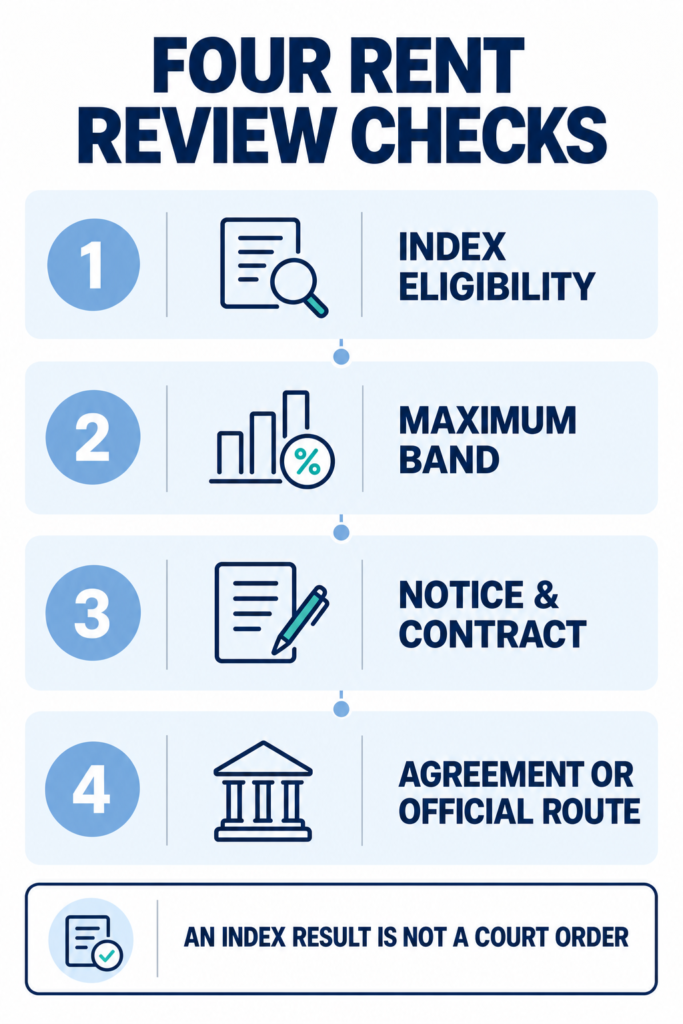
- Test the legal and contractual conditions: separate index eligibility from the notice and agreement questions.
- Communicate a traceable proposal: identify the current rent, proposed rent, effective renewal, basis and response route without presenting an unresolved point as settled law.
DLD lists Rental Index as an inquiry service. Treat its output as evidence for the calculation, not as a court order or a complete review of the contract. If the parties disagree about the inputs, notice, applicability or proposed terms, use the current official dispute-resolution route or obtain appropriately qualified advice.
Keep eligibility, percentage and notice in separate columns
| Column | Question | Evidence |
|---|---|---|
| Eligibility | Does the current official result place the tenancy in an increase band? | Saved official inputs/output and the correct property/contract records. |
| Percentage | What maximum band does Decree 43/2013 state for that difference? | The current legislation and calculation. |
| Notice | Was the proposed change communicated in accordance with the applicable law and agreement? | Dated contract, agreed amendments and provable communication record. |
| Agreement or resolution | Did the parties agree, or is an official dispute route required? | Signed renewal/amendment or the relevant official process. |
Article 14 of Dubai Law No. 26 of 2007 states that, unless the parties agree otherwise, a party wishing not to renew or to amend the terms must notify the other party at least 90 days before expiry. The phrase “unless otherwise agreed by the parties” matters. Read the actual agreement and current law rather than assuming one standard sentence controls every tenancy.
A timely message does not independently prove that a proposed increase is permitted. Conversely, a qualifying index band does not show that the communication and contractual steps were completed. Keep the columns separate until each has evidence.
Prepare the evidence file before contacting the tenant
- The signed tenancy agreement and any later amendment.
- The Ejari or other official tenancy details relevant to the current lookup.
- The property identifiers and classification used in the Rental Index.
- The existing annual rent and payment schedule.
- A dated copy of the official index inputs and result.
- The calculation connecting the result to the proposed amount.
- The contract-expiry and notice dates.
- A copy and delivery record for each material communication.
Make the file understandable to someone who was not part of the earlier conversation. Label assumptions, unresolved items and dates. If a unit, area, bedroom count, contract date or current rent was entered incorrectly, rerun the official check rather than editing the result manually.
How to write a clear renewal proposal
A renewal communication should identify the tenancy and the proposed change without overstating what an index can decide. Include the landlord and tenant names as recorded, property, current rent, renewal date, proposed rent or terms, the date of the official lookup, and a response route. Attach or make available the evidence appropriate to the communication method and privacy context.
Avoid saying that a private portal “proves market rent,” that a 20% increase is generally allowed, or that silence necessarily creates agreement. Do not combine a rent proposal with threats about eviction or enforcement. Those issues require their own statutory and factual analysis, which this guide does not provide.
Review the owner budget separately
The Rental Index addresses a rent-review question; it does not calculate the property’s net return. Maintain a separate owner worksheet for service charges, insurance, finance, management, maintenance, vacancy and other property-specific costs. Our Dubai service-charge guide explains how to verify that recurring jointly-owned-property input.
If you are buying rather than reviewing an existing tenancy, start with the Buying Property in Dubai guide. For a tenanted resale, use the ready and resale guide to make the tenancy, possession and transfer questions visible before completion. Do not assume that a future index result will cure a purchase assumption.
When to pause and seek an official or professional answer
- The official tool does not accept or clearly match the property information.
- The contract and official tenancy record show different dates, rent or parties.
- The proposed change falls outside the index calculation or includes other terms.
- The notice date, delivery or agreed notice clause is disputed.
- The parties disagree and a binding interpretation or remedy is required.
In those cases, keep the evidence intact and consult the current DLD/Rental Disputes Center route or an appropriately qualified adviser. General online guidance cannot determine the outcome of a particular dispute.
Frequently asked questions
Can a Dubai landlord increase rent by 20% every year?
No such general rule appears in Decree 43/2013. The 20% figure is the maximum band for a tenancy more than 40% below the average rental value under the official framework, and other renewal conditions still matter.
Is an asking-rent website the same as the Rental Index?
No. Private listings may provide commercial context, but the Decree identifies the RERA-approved Rent Index as the basis for the statutory average rental value.
Does 90 days’ notice make any increase valid?
No. Notice, index eligibility, the applicable band, the contract and any dispute are separate questions. Article 14 also contains the qualification “unless otherwise agreed by the parties.”
Planning to buy or hold a tenanted Dubai property?
DRI provides an initial property-planning discussion for international buyers and owners. Share the property stage, current tenancy position and the decision you are preparing. We can help organise purchase and ownership questions; DLD, the Rental Disputes Center and appropriately qualified advisers remain responsible for official results and advice.
Official sources checked on 14 September 2026: Dubai Decree No. 43 of 2013, Dubai Law No. 26 of 2007 and the DLD service catalogue. Laws, official index interfaces and procedures can change, and an individual contract or dispute may require specific advice. Recheck the current legislation, official Rental Index and relevant authority route before proposing or acting on a change.