
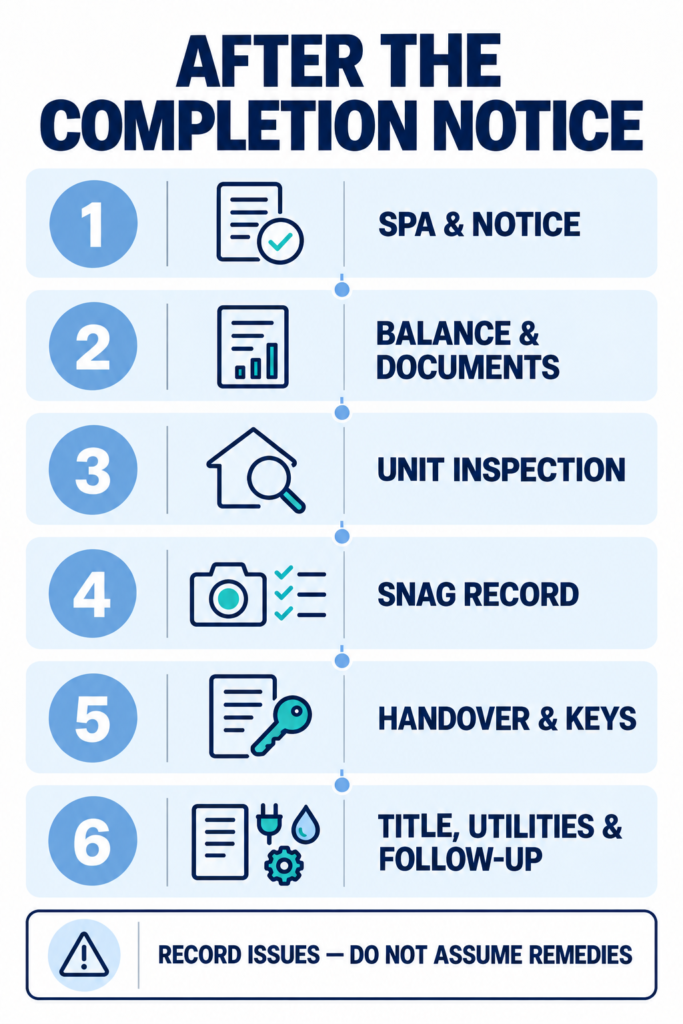
A developer’s completion or handover notice changes the buyer’s work. The question is no longer whether the project looks promising. It is whether the notice, signed SPA, outstanding balance, physical unit, handover documents and final registration evidence all describe the same transaction.
This guide begins after an off-plan buyer receives a completion or handover notice for a Dubai property. It provides a practical inspection and evidence workflow. It does not decide whether a payment may be withheld, whether a defect permits refusal of possession, whether a contract may be cancelled, or what remedy applies in a dispute.
In this guide, you will learn how to:
- match the completion notice to your SPA and unit records;
- prepare a dated inspection and snag record;
- separate keys, possession, registration and utility activation; and
- keep a first-year follow-up file without assuming a legal remedy.

Start with the exact notice, not a generic checklist
Save the complete notice, including attachments, sender details and delivery date. Identify whether it announces project completion, asks for a payment, offers an inspection slot, schedules handover, requests documents, or combines several steps. Marketing language such as “ready” should not replace the operative wording and dates.
Open the signed SPA and any valid amendment beside the notice. Match the purchaser name, developer entity, project, building, unit number, unit type and agreed specifications. Then locate the clauses for completion, instalments, final balance, inspection, handover, notices, registration, charges and default. If the documents conflict or a legal interpretation is required, preserve them and obtain appropriately qualified advice before acting.
| Notice item | Match against | Do not assume |
|---|---|---|
| Purchaser and unit | SPA, amendments and provisional-registration evidence. | That a project-wide email proves the exact unit is ready. |
| Completion or handover date | Notice wording, SPA trigger and current official records. | That project progress alone fixes the contractual date. |
| Amount requested | SPA schedule, receipts, statement of account and stated trigger. | That every amount labelled “handover” has the same basis. |
| Inspection access | Appointment, access rules and representative authority. | That an inspection appointment transfers possession or title. |
| Documents and charges | SPA, developer checklist, lender and registration requirements. | That another buyer’s list is complete for your transaction. |
Reconcile the balance and completion evidence
Create a payment reconciliation from the reservation payment through the latest instalment. Each line should show the contractual trigger, amount, payment date, verified recipient, receipt and remaining balance. Compare the result with the developer’s current statement rather than relying on a headline balance copied into an email.
Dubai Land Department’s FAQ explains a specific protection where an agreed payment schedule is based on construction completion rates: when the developer requests a payment, the purchaser may confirm the current percentage through a letter from a project consultant approved by DLD. This is not a universal rule for every SPA or every final balance. Use it only where the payment schedule and current facts fit, and verify the current official wording.
DLD’s Project Status Enquiry can provide project information and a completion percentage. Keep that result as one dated record. It does not independently prove that the buyer’s exact unit is defect-free, that an inspection occurred, that every handover condition is satisfied or that a particular payment request is valid.
If your question is still at the project-verification, escrow or initial-registration stage, return to the Dubai off-plan buying guide. This article deliberately starts later and does not repeat those pre-purchase checks.
Prepare the unit inspection before the appointment
Ask the developer what access is permitted, how long the appointment lasts, whether power and water will be available for testing, whether a professional inspector may attend, what personal protective equipment is required, and how issues must be submitted. If the buyer cannot attend, confirm the power of attorney or other authority the developer will accept before sending a representative.
Bring the approved or contractual specification available to you, the unit plan, finish schedule, appointment confirmation, a charged phone or camera, a measuring tool and a structured room-by-room checklist. The aim is not to produce a vague list of complaints. It is to create a traceable record tied to the correct unit and inspection date.
| Area | Practical observations to record | Evidence format |
|---|---|---|
| Identity and access | Unit number, floor, entrance, keys or access devices presented. | Wide photo plus appointment record. |
| Surfaces and joinery | Walls, ceilings, floors, doors, windows, cabinets and visible damage. | Room, location, close photo and scale. |
| Water and sanitary items | Visible leaks, drainage, fixtures, water pressure where testing is enabled. | Short video or photo with test condition. |
| Electrical and cooling | Visible fittings, sockets, controls and cooling operation where energised. | Item identifier and observed result. |
| External or allocated areas | Balcony, parking, storage and other items stated for the unit. | Location and identifying reference. |
| Documents and meters | Manuals, warranties, meter details and schedules supplied at the appointment. | Document name, version and date received. |
Some tests may be impossible if services are not active or access is restricted. Mark them “not tested” with the reason. Do not record an untested system as passed, and do not assume that receiving keys proves every system was tested.
Write a snag record that another person can verify
Give each item a unique number. Record the room or location, component, observable condition, photo or video reference, inspection date and requested follow-up. Distinguish a missing item, incomplete work, visible damage, functional test failure and specification question. Avoid diagnoses you cannot support; describe what was observed.
- Specific: “Bedroom 2, north window: handle does not close fully,” not “windows bad.”
- Located: identify room, wall, cabinet or fitting so the item can be found again.
- Dated: retain the inspection date and original media metadata where practicable.
- Traceable: keep the submission confirmation, developer response, proposed action and recheck result.
- Closed deliberately: mark an item closed only after the recorded condition has been rechecked.
“Snagging” is used here as a practical inspection-and-record process. A snag list does not by itself establish a right to stop payment, refuse possession, demand a particular repair deadline or cancel an agreement. Those questions depend on the contract, applicable law and facts. Keep the record intact if advice or an official process becomes necessary.
Separate inspection, handover, possession and title
These events may be connected, but they are not interchangeable. An inspection appointment gives access for a defined purpose. Handover may involve documents, acknowledgements, keys, access cards, manuals and responsibility dates. Registration establishes the official ownership record. Utility activation is another service process. Record each event and its evidence separately.
| Event | Evidence to retain | Open question to close |
|---|---|---|
| Inspection | Appointment, attendees, photos, tests and submitted snag record. | Which items remain open and when can they be rechecked? |
| Financial reconciliation | SPA schedule, receipts, statement and verified payment evidence. | Does every requested amount have a documented basis? |
| Handover | Signed documents, date, keys/cards, manuals, warranties and meter details. | What date starts each contractual or operational responsibility? |
| Final registration | DLD-linked ownership or registration evidence for the correct unit and purchaser. | Which developer, lender or DLD step is still pending? |
| Move-in setup | Utility, building access, insurance and management records. | Is the unit operationally ready for the intended lawful use? |
Dubai Law No. 13 of 2008 connects project completion and the completion certificate with registration of the completed project and sold units for purchasers who fulfilled their contractual obligations. DLD’s FAQ separately explains the movement of a fully paid unit from the initial register to the Real Property Register and issuance of a title deed or usufruct certificate. Do not promise a universal timeline: verify the status of the exact unit, buyer, developer paperwork and any lender requirement.
Plan utilities and recurring ownership costs
DEWA’s Activation of Electricity/Water (Move-in) service lists a Title Deed or Sales Purchase Agreement among the owner requirements, together with prescribed identity evidence. Check the live service page for the current documents, deposit, charges and processing information. Also confirm whether the building, meter and developer-side records are ready; a published service time does not guarantee access or activation at the handover appointment.
Prepare an owner-start file for building access, community rules, insurance, cooling where separately supplied, internet, parking, emergency contacts and the intended use of the property. If the unit will be operated as short-term accommodation, use the separate Dubai Holiday Home permit guide before listing it.
Keep annual service charges separate from one-off purchase and registration costs. Use the approved project, usage and year in the DLD Service Charge Index, then reconcile that reference with the unit-specific statement, relevant management or Mollak invoice and SPA terms. The index does not include arrears and does not by itself establish the exact amount due for a particular handover. See our Dubai service-charge checking guide for the full workflow and the Dubai property purchase-cost guide for one-off transaction costs.
Maintain a first-year defect and document log
Do not discard the inspection file after key collection. Keep a dated log of newly observed conditions, notifications, access appointments, developer or contractor responses and completed work. Preserve the original handover documents, warranties and manuals and record who accepted each report.
For jointly owned real property, Article 40 of Dubai Law No. 6 of 2019 provides developer liability for structural defects for ten years from the completion certificate and for defective mechanical, electrical, sanitary, sewerage and similar installations for one year from unit handover. The legislation also addresses the start of that one-year period if an owner refuses possession. This does not mean every cosmetic snag has the same legal treatment, and it does not prescribe one universal snag-submission deadline or repair service level.
DLD’s FAQ also describes a 5% escrow retention for one year after project completion as a defects guarantee. Do not interpret that as money controlled by the buyer, a guarantee that every defect will be repaired from it, or a right to retain a separate payment. For an actual unresolved defect, payment or possession dispute, obtain current official guidance or appropriately qualified advice.
Your handover control sheet
- The complete developer notice and delivery date are saved.
- Purchaser, developer, project, building and unit details match the SPA and registration evidence.
- Completion, payment, inspection, handover and registration clauses are identified.
- Every payment and receipt is reconciled to the current statement.
- The inspection appointment, permitted tests and representative authority are confirmed.
- Each snag has a number, location, observation, dated media and follow-up status.
- Untested systems and the reason are recorded.
- Keys, cards, manuals, warranties, meters and signed handover records are inventoried.
- The final registration or title workstream has an owner and next check date.
- Utilities, insurance, access and service-charge evidence are tracked separately.
- A first-year defect log is open and original evidence is retained.
Frequently asked questions
If you are still comparing transaction types or planning the acquisition as a whole, begin with the Buying Property in Dubai guide. It provides the route map; this checklist controls the narrower post-notice handover stage.
Does a DLD completion percentage mean my unit is ready for handover?
Not by itself. It is project-level evidence. Match the official result with the developer notice, SPA trigger, exact unit inspection, payment reconciliation and handover requirements.
Can I withhold the final payment until every snag is fixed?
This general guide cannot establish that right. Payment triggers, inspection provisions and remedies depend on the SPA, applicable law and facts. Preserve the evidence and obtain qualified advice before missing a contractual deadline.
Is receiving the keys the same as receiving the title deed?
No automatic equivalence should be assumed. Keep the handover record and the DLD registration or title evidence as separate workstreams until both are complete for the correct buyer and unit.
Should I hire a professional snagging inspector?
A professional may help document building systems and visible conditions, but first confirm access, authority, testing limits and deliverable format with the developer. The buyer should still retain the final record and responses.
Preparing for an off-plan handover in Dubai?
DRI Holdings can help you organise the property, document and ownership-cost questions for an initial planning discussion. We do not replace legal, engineering, lending or authority-specific advice.
Official service information and legislation checked on 15 September 2026. Requirements and procedures can change; verify the current DLD, Dubai Legislation and DEWA sources before acting.