
A non-resident can find mortgage products for a Dubai property, but that does not mean every lender, buyer, nationality, income source or property will qualify. The useful question is not simply “Can I borrow?” It is whether a named lender can assess your circumstances, approve the exact property and complete its work in time for the purchase contract.
This guide is for buyers who live outside the UAE and are considering finance for a Dubai purchase. It explains the eligibility questions, evidence pack and handoffs between lender, seller, developer, conveyancing parties and Dubai Land Department (DLD). It does not compare live interest rates, promise approval or treat one bank’s terms as the market standard.
In this guide, you will learn:
- how a regulatory lending ceiling differs from a bank offer;
- which non-resident questions to settle before reserving a property;
- how to build a traceable income, funds and property evidence pack; and
- where mortgage work connects to valuation, transfer and registration.

Start with the difference between a ceiling and an offer
The Central Bank of the UAE (CBUAE) mortgage rules set maximum loan-to-value ratios for specified borrower and property categories. Those limits constrain regulated lenders; they are not a quotation to an individual borrower. The rules also state that a lender may choose a lower LTV after considering the risk of the collateral.
The distinction matters for non-residents. The regulatory tables use categories such as expatriate, owner-occupier, subsequent or investment property, and off-plan scheme. “Non-resident” is not automatically identical to every expatriate category. A bank must still decide whether it offers a suitable non-resident product, accepts the buyer’s country and income profile, recognises the property, and can meet its own affordability and credit requirements.
| Layer | What it can tell you | What it cannot prove |
|---|---|---|
| CBUAE regulation | The maximum regulatory boundary for a defined category. | That a particular bank will lend to you at that limit. |
| Bank product page | A lender currently markets a product and may show headline limits. | That every applicant, nationality, property or purpose is eligible. |
| Decision in principle | The lender has assessed stated borrower information to a preliminary stage. | Final approval of the property, valuation, documents or transfer. |
| Final offer and completion instructions | The approved facility, conditions and completion process for the transaction. | That every external party has completed its own work. |
For example, HSBC UAE currently advertises a non-resident mortgage with borrowing up to 60% of property value, subject to its customer and product conditions. That is evidence about HSBC’s named product, not a rule that all Dubai non-resident mortgages use a 60% ceiling. Other banks may define eligibility and execution differently. Always obtain a dated offer and Key Facts Statement from the lender you are actually considering.
Answer seven eligibility questions before choosing the unit
- Applicant: Will the borrower be one person, joint applicants or a company?
- Residence and nationality: Does the lender serve the applicant’s country of residence and citizenship?
- Income: Does it accept salaried, self-employed, company-owner, investment or mixed income from the relevant jurisdiction?
- Currency: How will the lender treat income, assets and liabilities denominated outside AED?
- Purpose: Is the property for personal use, a second home or investment?
- Property: Is the exact ready or off-plan property acceptable to the lender?
- Timing: Can valuation, final approval, signing and registration fit the contract?
Do not reserve a unit on a generic online calculator alone. Ask the lender or authorised intermediary to record the assumptions behind any indication: purchase price, valuation basis, property type, intended use, applicant structure, income currency, existing debt and expected deposit. If any assumption changes, the indication may no longer describe the transaction.
If you are still deciding between a completed and an off-plan property, use the Buying Property in Dubai guide to choose the transaction branch first. Off-plan lending has its own regulatory category and lender/project eligibility; a facility available for a ready apartment should not be carried across to an off-plan booking.
Build the evidence pack in three folders
The lender’s current checklist controls the application. The following structure helps you collect the requested evidence without pretending that every bank requires the same documents.
| Folder | Typical evidence questions | Quality check |
|---|---|---|
| Applicant | Passport, address, residence status, employment or business role, tax and contact details requested by the lender. | Names, dates and addresses are consistent; translations or certifications meet the lender’s instructions. |
| Income and funds | Salary or business evidence, bank statements, liabilities, deposit source and transfer trail. | The period, currency, account holder and source of each material amount are clear. |
| Property and transaction | Offer or agreement, property identifiers, seller/developer documents, payment schedule and valuation access. | The unit, price, parties and deadlines match the current contract version. |
Ask for two lists in writing: documents needed for preliminary assessment and documents or conditions needed before drawdown. The second list is easy to miss. It may include a satisfactory valuation, original or certified documents, insurance, account arrangements, signed facility papers, developer or seller documents and registration appointments. A preliminary approval does not close those conditions.
Keep a simple version register. Record the document name, issue date, period covered, currency, translator or certifier if applicable, date submitted and the lender’s response. Where funds move between countries or accounts, keep the transfer trail rather than only the ending balance. Do not email identity or bank records to a property salesperson unless the named recipient, purpose and secure method have been verified.
Connect finance to the purchase timeline
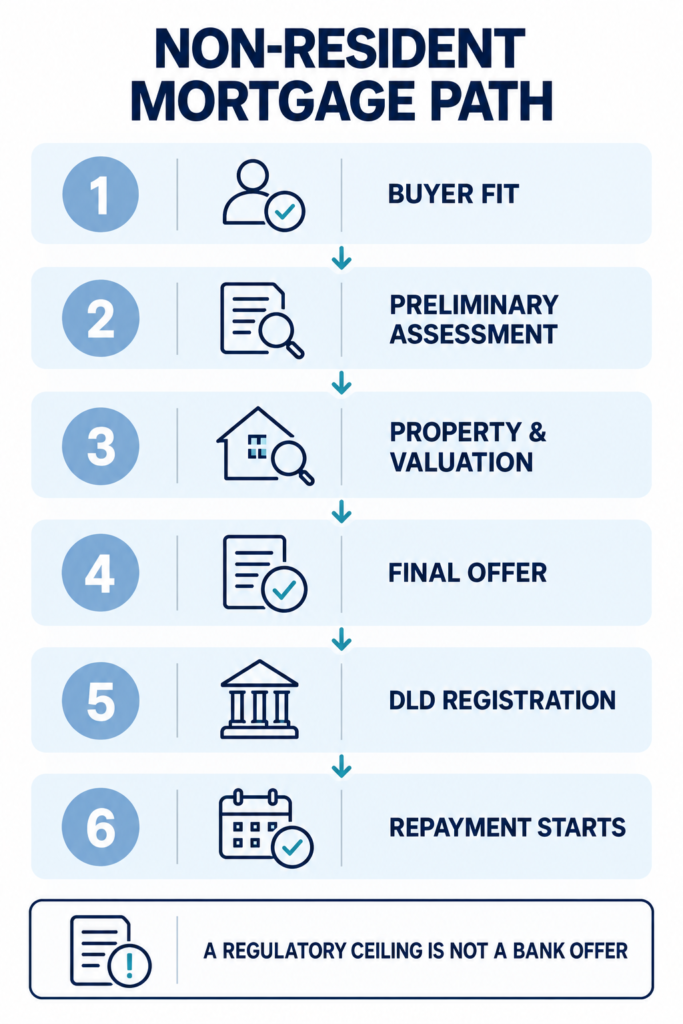
A non-resident mortgage is not a separate administrative task that can be added after the sale timetable is fixed. It must be connected to the transaction from the first material commitment.
| Stage | Mortgage question | Purchase control |
|---|---|---|
| 1. Budget | Which lender, product and borrower assumptions are being tested? | Keep deposit, fees and reserve funds separate from the headline loan amount. |
| 2. Preliminary assessment | What has the lender actually reviewed, and what remains conditional? | Do not call an estimate final approval. |
| 3. Property selection | Is the exact property acceptable, and who arranges valuation access? | Make finance and valuation deadlines visible in the agreement. |
| 4. Final approval | What conditions, documents, insurance and signatures remain? | Reconcile the final price, valuation, deposit and completion funds. |
| 5. Registration and transfer | Who attends, who sends funds, and which mortgage record is created? | Use the lender, DLD/Trustee, seller and developer instructions for the same transaction. |
| 6. After completion | When do repayments, account obligations and document custody begin? | Check title/mortgage evidence, keys, insurance and recurring ownership costs. |
DLD provides a mortgage-registration service and lists a passport among the identification documents for a non-resident foreign owner in the relevant route. That does not approve the loan. It describes the land-registration work once the transaction and lender requirements are ready. The bank, DLD or Registration Trustee, seller and developer may each control a different document or appointment.
HSBC’s current non-resident product page, for example, describes land-department registration and in-person signing after approval. Treat that as HSBC’s process and ask your chosen lender to map its own sequence. If you are buying a completed resale, compare it with our ready and resale transfer guide, especially where the seller already has a mortgage.
Create a completion funds sheet
The deposit is only one cash requirement. Create a dated sheet with the purchase price, lender valuation, approved facility, buyer equity, DLD and Trustee charges, mortgage registration and valuation charges, broker or advisory fees, insurance, bank charges and a separate contingency. Mark whether each figure is confirmed, estimated or excluded.
Our Dubai property purchase costs and DLD fees worksheet explains the transaction-cost layer. Do not merge the lender’s finance amount with the cash needed for registration and other costs unless the final facility documents expressly do so. Also allow for recurring ownership costs, including the property-specific service-charge position.
Use three stop points
- Before reservation: stop if the lender has not confirmed that the applicant and property type can enter its assessment route.
- Before an unconditional commitment: stop if valuation, final approval, finance conditions or completion deadlines are unresolved.
- Before transferring funds: stop if the payee, account, amount, purpose or written instruction conflicts with the contract, lender or official transaction channel.
If residence is also part of the plan, keep it as a separate workstream. Mortgage approval does not decide immigration eligibility, and a residence service may assess property value and finance evidence differently. See the property purchase and Dubai residence guide before linking the two timelines.
Frequently asked questions
How much can a non-resident borrow for a Dubai property?
There is no single percentage that can be stated for every buyer. CBUAE rules set regulatory maxima for defined categories, while each lender sets product, borrower and property criteria. Obtain a dated indication and final offer from the lender rather than converting a regulation or another bank’s webpage into your expected facility.
Is a decision in principle enough to sign?
It is not final property approval or proof that all completion conditions are satisfied. The contract should be reviewed with the finance, valuation and completion dependencies made explicit.
Can the lender rely on expected rent or price growth?
CBUAE rules require an appropriate repayment assessment and state that it should not rely only on future property appreciation or expected future income growth. Do not build the purchase around a guaranteed rent, resale price or refinancing outcome.
Planning a financed Dubai property purchase?
DRI provides an initial property-planning discussion for international buyers. Tell us your current country, intended buyer, approximate budget, ready or off-plan preference and whether finance is being explored. Identity or bank documents are not needed in the first enquiry, and a lender remains responsible for its own approval.
Official sources checked on 14 September 2026: CBUAE Mortgage Loan Regulations and LTV amendments, DLD Request for Mortgage Registration, HSBC UAE non-resident mortgages and Emirates NBD expatriate home loans. Products, eligibility, rates, documents and procedures can change and remain lender- and transaction-specific. Confirm the current position with the chosen lender, DLD or Registration Trustee and appropriately qualified advisers before signing or paying.